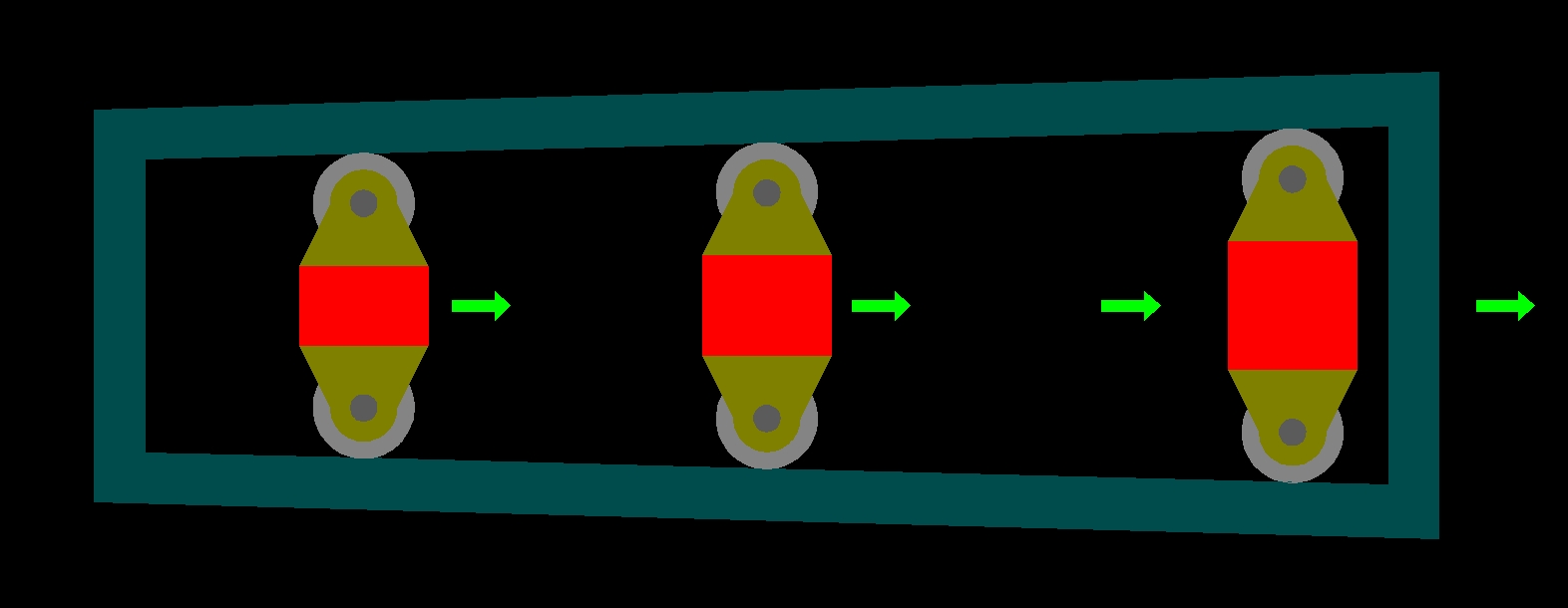
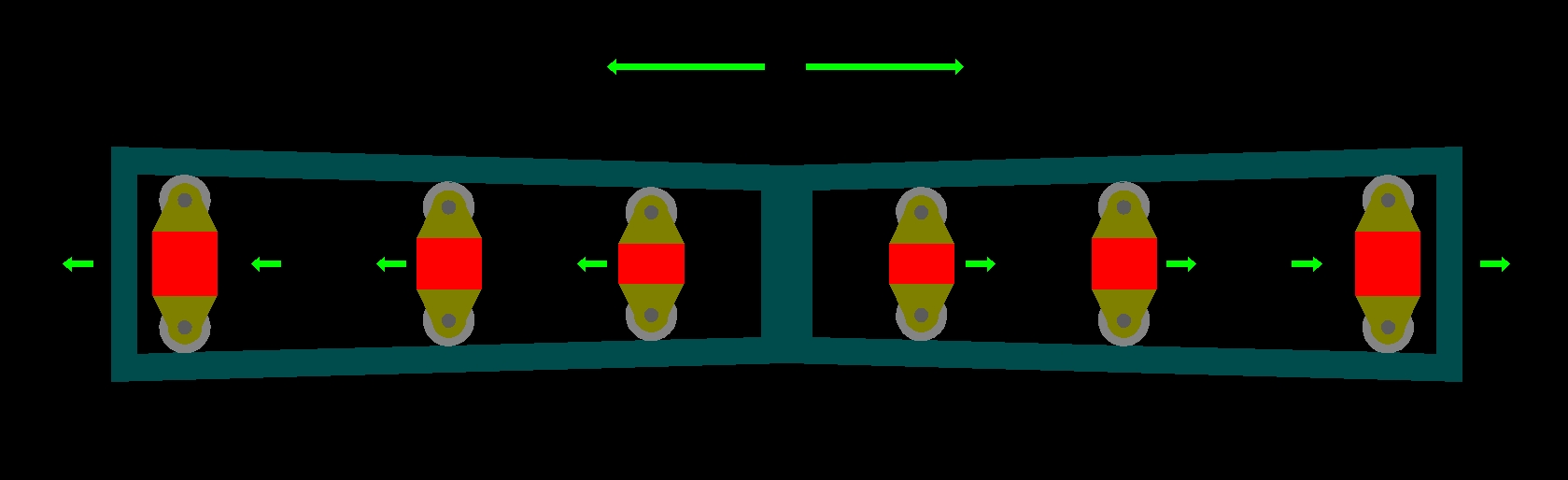
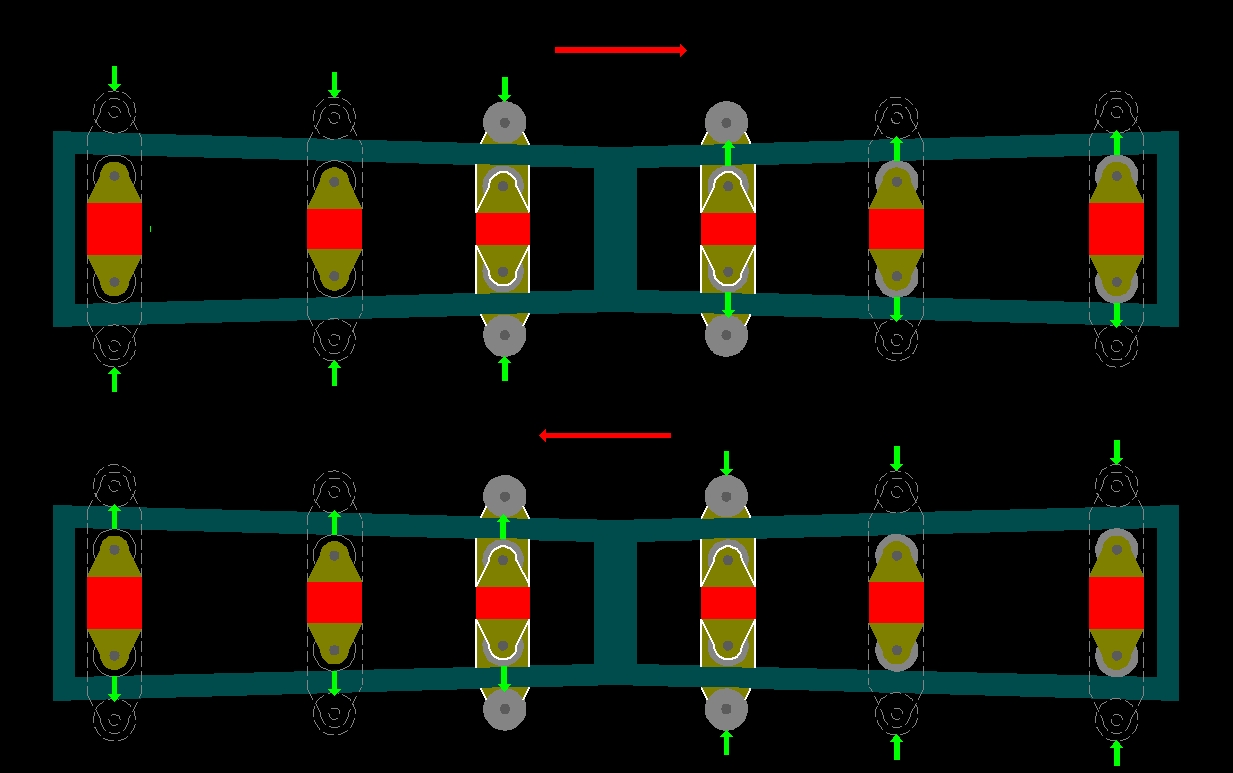
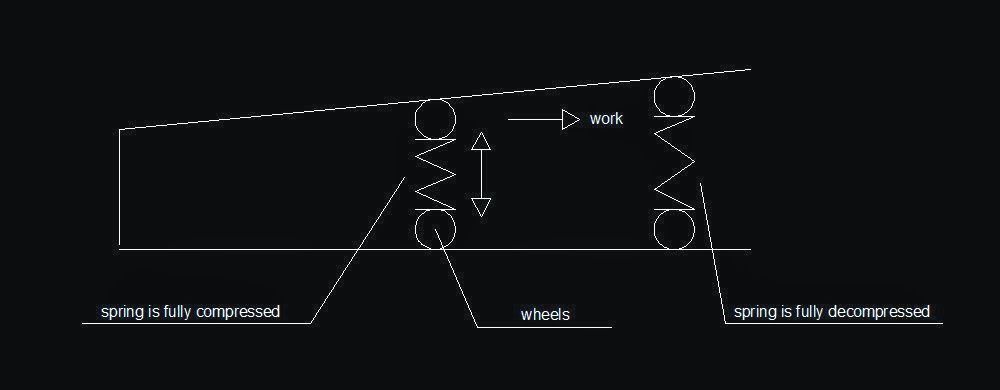
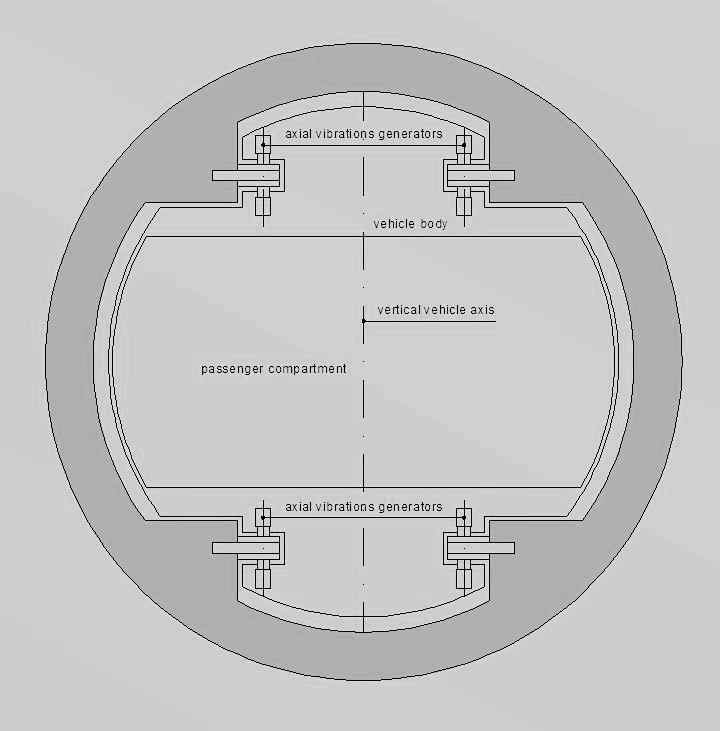
Thermal electromagnetic propulsion is based on thermal expansion of materials like metals. In the process the electromagnetic energy is changed to work - kinetic energy to propel vehicles with application of untypical guideway the vehicle is moving ahead. This internal energy is coming from the atomic structure of metallic solids medium. After delivering the heat energy to the atoms in solids atoms start to increase external dimensions of its structure. Obtained in that way changes in geometric dimensions are predicted to give away mechanical energy with the application of precisely setting of double surfaces. Thermal energy is directly converted into mechanical energy in this case. The application of wheels is optional and less practical. To proper functioning of the entire system there is a need to apply the axial vibration generators made from hard and heat resistant materials due to the generators may generate a lot of heat because of friction, which heat will be returning to expansion sustaining system at the same generators, what will increase the efficience of entire system. After the system is warmed up with external sources of heat, should be sustaining heat from the friction so the system has automatic delivery of energy after it start to move ahead. The system for now is predicted to work with efficient coolant but this efficiency is depending on geometry of entire movement track, the more inclined track means the more powerful acceleration, but one should remember that this inclination can't be too big, because there is no such a material due to thermal expansion which could be here used. The system will work with not big inclination of the track and with a proper length of the partial tracks of entire track line due to proper cooling of the system and reheating. One should remember that the system is based on changing thermal energy delivering to the axial vibration generators to obtain the changing geometry of the cores ot those generators.This system of propulsion is designed for small ground levels differences. The track must be in the range of inclination allowing the vehicle to move on the track which is aproximatelly perpendicular to gravity vector acting as the planetary mass. So, the better result applying this technology is such a designing of the track place which will mean not a lot of displacement in vertical plane. The system is capable to disturb Earth's gravity field on the deck of the vehicle. The system also should be considered as potentially able to control gravity vector on the deck with great velocity of the vehicle. The propulsion method can be obtained by using mechanical resonance - once the vertical movement of axial vibration generator stater core is swiched on the system should automatically undertake the work and the slightly warming up the system should give the proper speed control of the vehicle. Everything is depending on the technical parameters of the track and the vehicle software.
Expansion, work in one direction
Expansion, two directions
Fully operating system
9 September 2020
A propulsion system solution utilizing thermal expansion is perhaps a somewhat unexpected proposition, given current technological trends. Although thermal expansion of materials, which affects their geometric dimensions, leads to only minor overall changes, such as increases in length, volume, or circumference. Considering the considerable precision that would be required for such a solution and the multitude of technical challenges that could arise, this idea has not yet been eliminated due to significant errors in the assumptions. Ultimately, and ultimately, much depends on the sophistication and work factor involved in "polishing" the technology, the fundamentals of which are presented here. As we know, changes in the geometry of objects can be caused by electromagnetic, relativistic, or gravitational wave effects. I will focus on the former possibility here. An object located within the range of an electromagnetic field in the thermal infrared band absorbs electromagnetic energy through a network of atoms, which in this process vibrate. These vibrations are spatially unpolarized and occur in all directions, leading to a change in geometry, particularly in the largest dimensions. A long steel rod heated uniformly along its entire length, whose width-to-length ratio is many times smaller, will correspondingly increase its overall length, while its circumference or width will change little during the heating process relative to its length.
Operation principle.
9 September 2020
A significant feature of such systems is that resonance can occur, in which the entire system is subjected to high-frequency vibrations. Therefore, no additional energy is required to achieve proper operation. Resonance can occur when the entire system, induced by a starter, oscillates along the vertical axis. Resonance is caused by forces originating from the axial oscillators on which the entire system is suspended and on which it also rests. The use of iridium has both technical and practical justifications, as it is an element with an exceptionally small atomic radius, is hard and indestructible, and is not subject to oxidation, making it ideal for this application. However, it is a scarce element worldwide, so its use here is unfortunately quite controversial. Iridium produces exceptionally smooth surfaces, impossible to achieve with many other materials of high hardness and durability. In this case, all dust and particles along the route are larger than the frontal clearance of the train, as we are in fact dealing with distances smaller than, or comparable to, the diameter of a hydrogen atom. The inclination profile is also a matter of debate, as it has subatomic dimensions, and therefore the precision of such a drive system must be extremely high. The resonant system would be powered by axial vibrators, as vibrations are needed to update the train's position and also reduce local friction. The method for achieving acceleration here is to increase the vibration frequency by reducing the distance from the top and bottom of the double rail, which could be achieved by heating the axial vibration generator insert. Increasing the geometric dimensions of this insert increases the frequency while simultaneously decreasing the vibration amplitude.