Plasma
9 September 2020
Plasma is a state of matter that involves the complete ionization of atoms (in plasma, atoms are completely devoid of electrons). Plasma can have, and currently has, a wide range of applications in technology, including space technology. Plasma is often said to be the fourth state of matter, but knowledge about it remains relatively limited. Many scientists, such as Sergei Korolev, who built what is believed to be the first plasma tokamak in the 1950s, have continued to attempt to harness the energy of heated plasma, as only under these conditions can matter undergo thermonuclear fusion.
Accelerated plasma
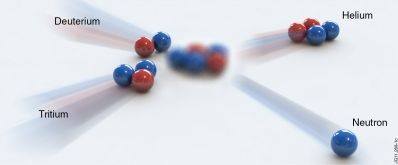
Deuterium and tritium
9 September 2020
Magnetic plasma confinement in electric field as a attempt to obtain electric field propulsion able to propellant-less cosmic interplanetary journey within solar system. However magnetic plasma confinement is still not complete technology created already on earth by humans and still plasma as a state of matter is not enough well-explained side of recent physic, thus thinking about space journey with application of this kind of technology looks like another fable from distant future book. But according to recent fast progress in science it seems to be a reality within several decades.
Plasma in a magnetic trap
9 September 2020
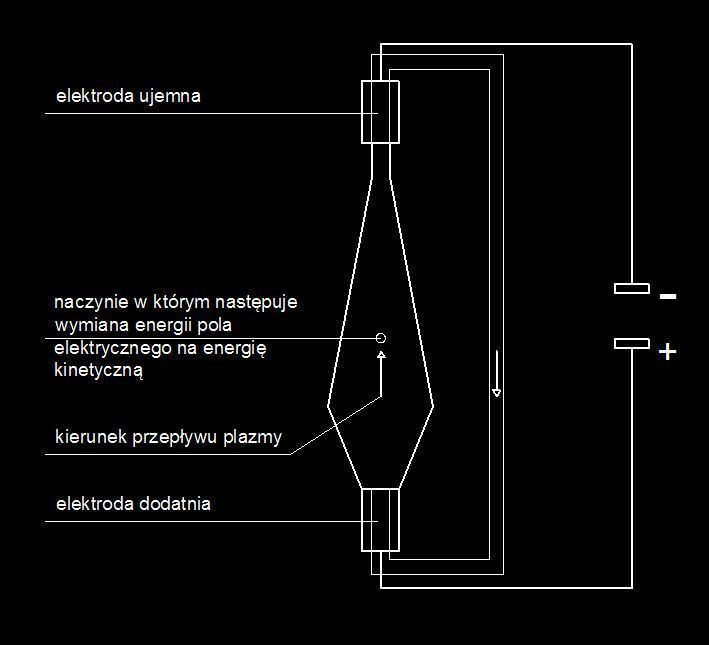
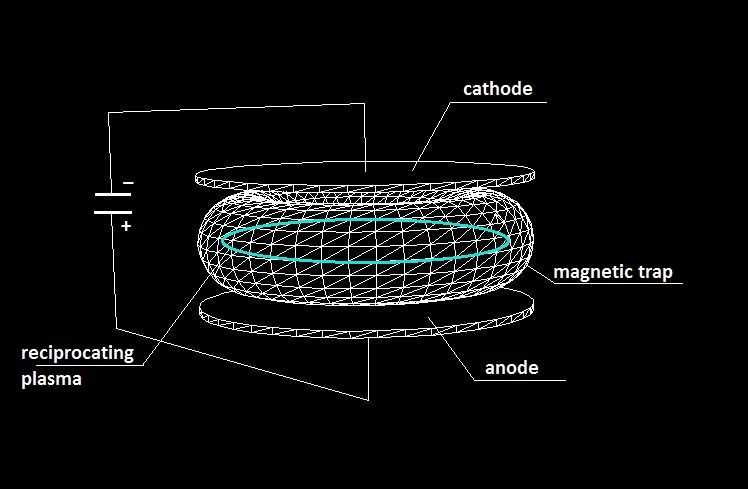
Plasma responds to an electric field (electric voltage) and can be accelerated using this field. The energy of the electric field can then be converted into the kinetic energy of the plasma, which can then be used to generate mechanical forces used to propel certain devices and vehicles. Existing space technologies utilizing plasma acceleration, such as in ion propulsion, generate very weak thrust by accelerating the plasma (ions) and ejecting it with high energy, as in a conventional rocket engine. The problem is that this solution constantly loses the working medium, the supply of which is limited in the tanks. In another situation, as in the figure above, the plasma circulates in a closed circuit, so there is no problem with its loss. The only problem is providing the required ionization energy, which can be provided by, for example, a radioisotope generator or a nuclear reactor. This type of solution assumes that plasma ions, as they bounce off a kinetic exchanger, will be propelled by an electric field and release their kinetic energy into the exchanger. This is a reversal of the situation in which gases create an overpressure that propels the rocket in a conventional rocket propulsion system. Whether this will work is difficult to verify without conducting an experimental phase. Any movement of electrically charged particles additionally generates a magnetic field. Considering this, it's important to consider whether this field will interfere with the operation of such devices. Protection against plasma recombination must also be ensured. The figure is only illustrative; in reality, many necessary technical solutions would need to be considered, which need not be mentioned at this time. There may also be other conditions that would prevent the construction of this type of propulsion, which I am currently unable to identify. One of these is the solution to plasma return, which could pose significant challenges.
Toroidal tokamak
Plasma confinement
9 September 2020
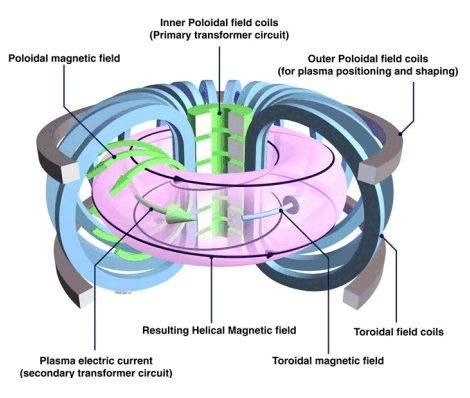
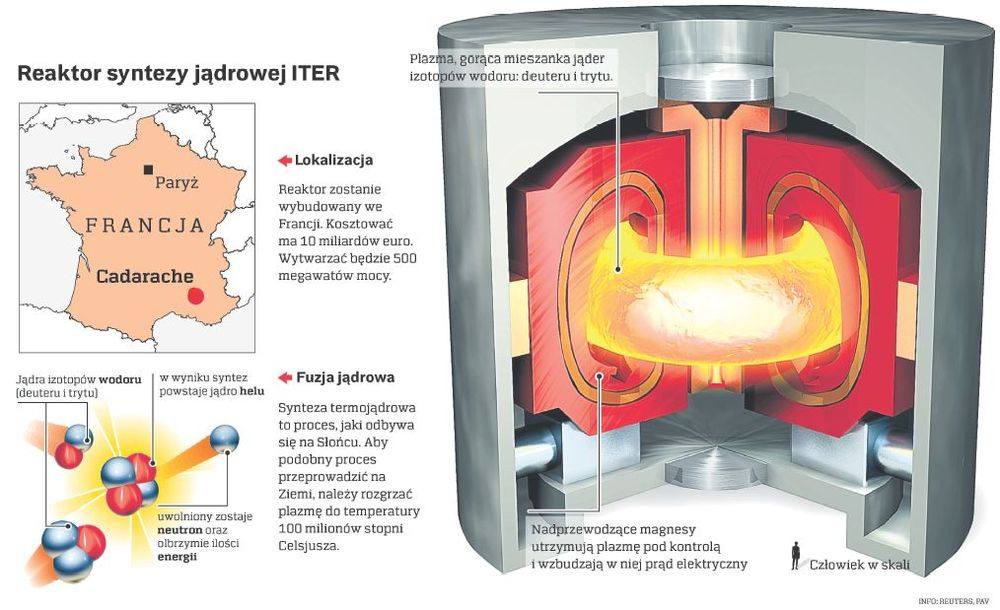
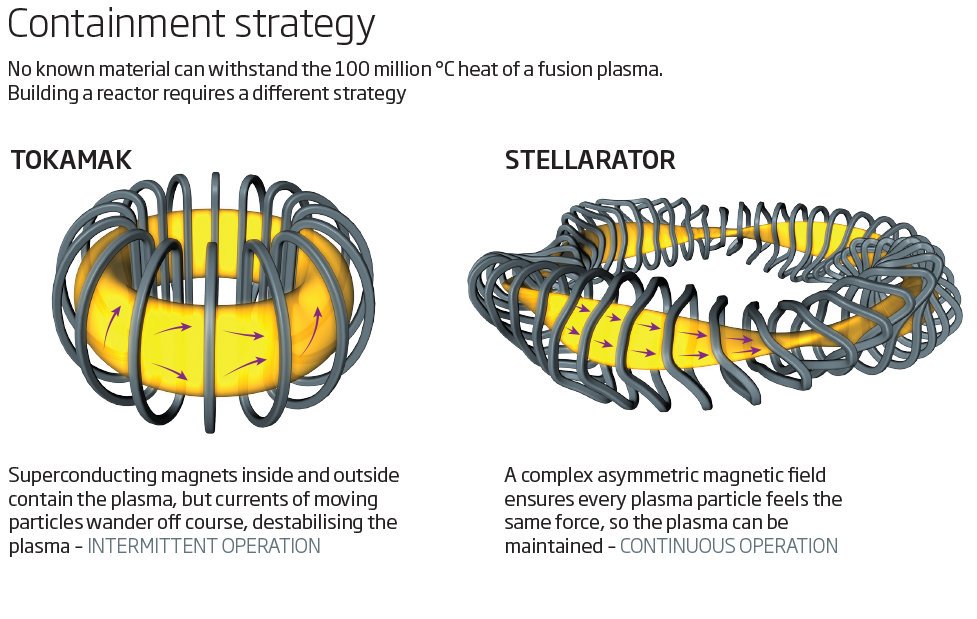
Various strategies for confining plasma to produce energy from thermonuclear fusion currently exist. The conventional tokamak system, currently under construction in France (ITER), China (EAST), and the United Kingdom (MAST, JET), utilizes a toroidal tokamak design in which the plasma is destabilized by currents within the plasma itself. This allows for a thermonuclear reaction time of no longer than 60 seconds in this type of tokamak, often resulting in a negative energy balance. The stellarator has a different design that allows for control of the plasma within the stellarator, and the plasma is subjected to the same forces throughout, ensuring continuous operation.
Tokamak and stellarator
Thermonuclear propulsion.