10 October 2024
Electricity from inertia.
Electricity, which could be generated from the inertia of solids or liquids under gravity, is not currently a common technique that can be applied on a large scale in the energy sector. Currently, there is no technology enabling the production of electricity using similar methods, except for hydroelectric power plants, where the inertia, or if you prefer, the gravitational and potential energy of water is widely exploited to convert the mechanical energy of water into electric current from generators using water turbines. Another way to utilize the inertial energy or inertia of a solid, not a liquid, can take various forms. For example, the conversion of mechanical energy to electrical energy can be achieved using an inclined plane. In this case, the potential energy of the body rolling down the plane is lost in favor of rotational energy. When the rolling body is subjected to low-friction solutions, such as rollers or wheels, the rolling system rotates during the fall, which can generate electricity, for example, by using an alternator connected to it.
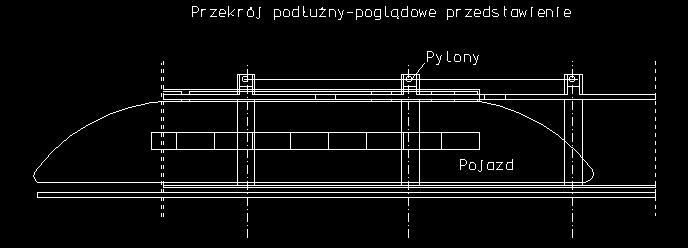
However, once the lowest point is reached, this type of energy production becomes impossible, and to continue producing energy, the same energy that was previously drawn from the energy production system must be supplied. This is therefore nonsensical from a practical perspective. However, one could consider whether it might be possible to change the final balance, which is equal to zero, in some as-yet-undetermined way, without resorting to overly complex technological methods. In principle, for this type of technological and practical problem, solutions based on magnetic fields cannot always be applied in a manner that is both functionally efficient and cost-effective. Instead, we should consider the use of directly intrinsic forces. As we know, a magnetic field is not necessarily of this nature, as it involves the movement of electric charges, and the movement of charge must be caused by a more primary factor, in this case most often the electric field and its changes. However, if we consider the electric field itself, or more specifically the electrostatic field, or the interaction of electric charges with each other resulting from the properties of this field, we have two types of possible interactions, one of which is the Coulomb force. By using certain metals previously polished to the point where electrons from the electron shell of one plate can interact with protons from the other plate in the layer closest to them, and vice versa, we are dealing with a potential prelude to achieving a lifting force that can act opposite to the gravitational acceleration vector. This force can be so significant that the supporting surface of the plates balanced by gravity can be truly small. We have a system here that, with precise electronic control, could be equivalent to using a much more expensive system of electromagnets, which would perform the same work but consume a large amount of current. Using permanent magnets of sufficient strength on both sides on a long route is economically absurd. This route is the very essence of the technological solution we are discussing. Let's assume we have the task not only of generating electricity per se but also, for example, of transporting cargo or passengers over any distance, as long as we're talking about planetary conditions. But how can we reconcile these two functionalities? The cargo, any mass, including the mass of people on board, creates a gravitational force vector directed toward the Earth's center of gravity whenever the weight is between the balanced suspension force and the gravitational force resulting from universal gravity. This is the appropriate moment to apply the previously mentioned inclined plane, as well as appropriately precise electronic control of the entire energy acquisition and transport system. As long as the slope of the plane from its beginning to its end, and its length (which must be optimally calculated), do not exceed the limiting forces resulting from the average distance over which the load-bearing capacity is ensured via Coulomb forces, it can be assumed that the limiting forces can be precisely balanced using the on-board computer equipped with the traction system, which feeds current into the external power grid. This is because gravitational energy is immediately converted into kinetic energy and, consequently, electrical energy. The forces acting here may seem small, but if we use an additional lower rail, utilizing the same form of charge interaction as at the top, but applying it without profiling on an inclined plane to further reinforce the gravitational forces, we have significant and stronger forces that can appear, especially after the train has accelerated significantly. Such a train can also run only in a circular motion, generating energy without any significant transport purposes. With this additional rail, the system will be able to move uphill, a possibility in which gravity is not required at all.
10 October 2024
Flywheel and Faraday's disc.
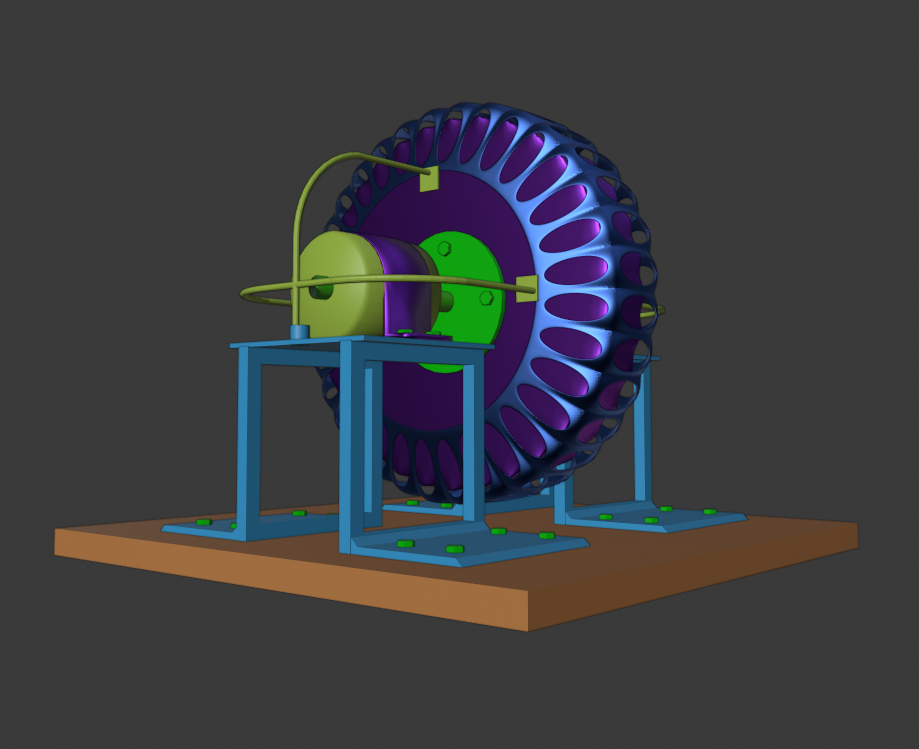
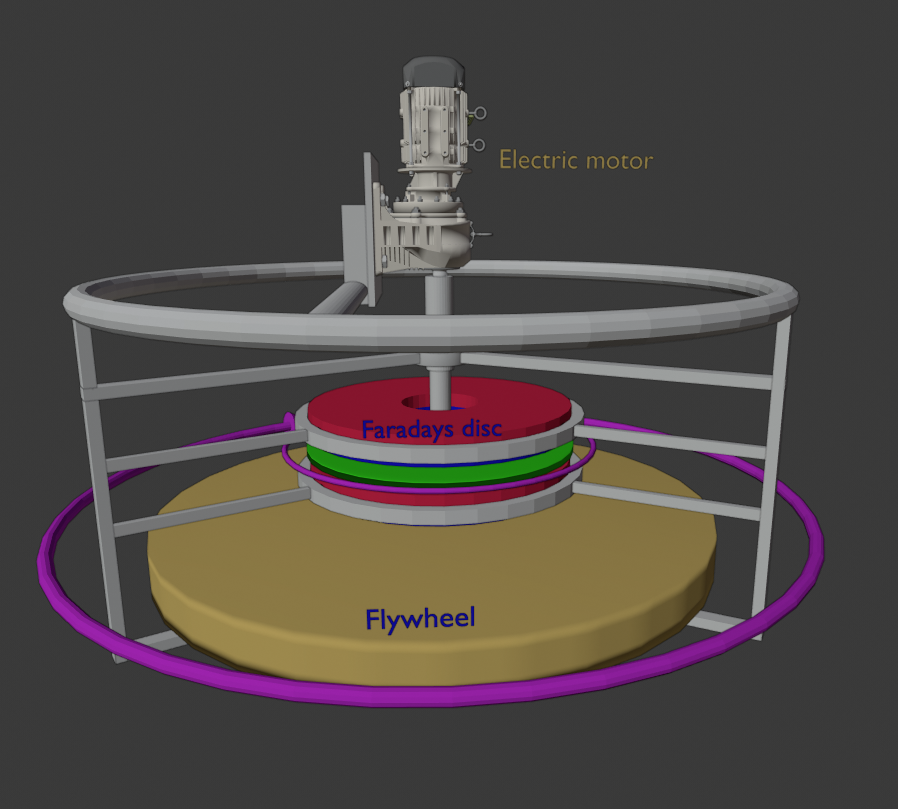
Faraday's disc permanent magnet device and I also add a flywheel. This is only a scheme. Flywheel is gathering energy to overcome Faraday's disc magnetic resistance. Part of energy is delivered to electric motor, the rest is predicted to power some external devices. The device is inspired and designed on the ideas of Bruce Depalma inventions. The flywheel sustain rotation by its own inertial energy in this device, without this flywheel the entire device will stop due to friction and magnetic resistance of the disc. The flywheel should be heavy enough to sustain the rotation (not too big for electric motor capabilities, not too small thus the system could have insufficient inertial energy to work). Once it is propelled by the electric motor to a proper rotational speed, entire system will work partially and simultaneously with much less power consumption from the electric motor. It means that the energy delivered by electric motor to the system is needed only to sustain rotation, where energy from the flywheel should be sufficient to abate this energy requirements of the system, to the level in which it can sustain own working and additionally give away electric power to a load - some external electric receiver.