Annihilation vs. fusion
9 September 2020
Solar energy is the energy available on Earth. When thinking about solar energy, two types and methods of obtaining energy come to mind: the first solution is to harness the solar energy reaching the Earth's surface in the form of electromagnetic radiation. The second is thermonuclear fusion in planetary environments, a method of harnessing the energy that actually powers the Sun as one of countless stars in the cosmos. Currently, the Sun's electromagnetic energy is almost entirely dissipated throughout the solar system, and only a negligible portion of it reaching the surfaces of planets in the solar system can be of any use. It also fuels processes in the planets' atmospheres and influences thermal conditions within them. As the only known inhabited planet in the solar system, Earth is a place where any changes in solar activity have a crucial impact on the humans and animals that inhabit it. Throughout history, there have been instances where solar activity, meaning the amount of energy reaching Earth, was significantly lower than normal. This resulted in various fluctuations in the size of the ice caps. During certain periods, when the sun was at its lowest, these caps expanded to such an extent that the present-day territory of Europe was covered by an ice sheet. In other periods, when the sun heated up more intensely, heat waves occurred, the climate could become humid, and the oxygen content in the atmosphere could reach 38%. In still other periods, carbon dioxide levels rose due to large volcanic eruptions and meteorite impacts to such an extent that the greenhouse effect intensified, leading to desertification. Today, the sun is the celestial body that can provide humanity with a virtually unlimited amount of energy for the needs of its technological civilization for thousands of years to come. As humans, we have the technical means to harvest solar electromagnetic energy and convert it into electricity using photovoltaic cells, or to exploit the phenomenon of thermonuclear fusion, such as that occurring within the sun, to build thermonuclear reactors, whose energy gain is incomparably greater than that of photovoltaic cells. Existing technologies, based on knowledge of nuclear physics, allow the construction of tokamaks and other devices in which ionized hydrogen fuses into helium, producing vast amounts of thermal energy. Hydrogen is the most abundant element in space and is also the primary fuel used to power stars. In main sequence stars, to which the sun belongs, maintaining fusion is simple: gravitational compression of gas until the repulsion between atoms is broken and they begin to fuse together, generating thermal energy. In Earth's environment, gravitational compression is impossible, and the only way to compress hydrogen is to trap it in magnetic fields. Hot plasma cannot touch the walls of a vacuum vessel, as it would melt violently, as its temperature is many times greater than that of our star's core. The Sun burns hundreds of thousands of tons of hydrogen per second, converting it into heavier helium. Research on increasingly better photovoltaic cells?more efficient versions?is ongoing in many laboratories around the world. As long as we remain on Earth, it is essential to draw energy from the largest source in the solar system, the sun; it will continue to provide it for billions of years. In recent years, there has been a particularly rapid development of fusion reactors, from devices like the JET and MAST to the largest reactor currently under construction, ITER, which uses deuterium and tritium as nuclear fuel. Obtaining deuterium is relatively simple - it occurs in seawater in combination with oxygen as heavy water, pure heavy water is obtained by long-term electrolysis of ordinary water, then heavy water is split into oxygen and deuterium. Tritium is a radioactive isotope of hydrogen and is more difficult to produce. It is produced from lithium by neutron irradiation. This process uses the same neutrons produced during tokamak operation. Since the tokamak is clad in lithium, it produces its own fuel. Thermonuclear fusion emits neutrons and high-energy electromagnetic radiation, however, there are variants of fusion that do not emit neutrons, known as neutronless fusion. The lightest form of hydrogen, protonated hydrogen (protium), is unsuitable for energy production because the energy required to fuse its nuclei into a helium nucleus is too high, and under Earthly conditions, it is impossible to achieve the appropriate conditions for a thermonuclear reaction involving atomic hydrogen.
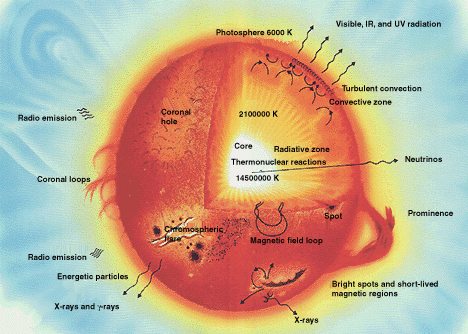
The game of fusion and its practical application is still ongoing, with the survival of humanity at stake. Clean energy offered by the sun is now becoming a priority, and in many countries whose environments have been polluted by human activity, it has become the most important element of energy management. On the one hand, we have wind energy and hydropower, but photovoltaics and fusion are the least environmentally invasive technologies, and it should be expected that work on them will continue until the desired results are achieved. On the other hand, we also have a return to the use of unconventional fuels in nuclear reactors, but the extent to which this will become a reality cannot be clearly determined. It seems that the clockwork industry dislikes more penetrating technologies, because technological revolution is not a legitimate or adequate form of economic development immediately. As long as certain solutions are available, a market exists for them, and the machinery is working, they will be used. Progress is a double-edged sword. Some will win and some will lose in the process. All changes have their significance and impact on economic stereotypes. However, before they reach this stage, the system will be verified with all its consequences.
The rest mass of an electron is several thousand times smaller than the rest mass of a proton. The proton-electron pair forms the simplest atom of hydrogen in nature (protium). The antiproton-positron pair, in turn, forms the simplest atom of antimatter ? antihydrogen. However, before mass production of antihydrogen on an industrial scale for energy production in power plants occurs, it is perhaps worth considering the much safer annihilation system of electron-positron pairs, as this type of system seems to be a more reasonable solution for energy production in annihilation power plants and other devices for energy production using this type of process. First, an electron creates an electric current that flows in a conductor. A similar situation applies to a positron. However, the problem is that for electron and positron currents to annihilate, a neutral medium must exist in which the process of generating and transferring gamma and thermal energy quanta occurs. These quanta could then be used to power a steam generator for turbines producing electricity in power plants. Both particles, the electron and the positron, possess an electric charge, but in exactly the opposite direction. In the case of electron-positron pair annihilation, high-energy gamma radiation is produced?exactly two quanta, which can be lethal to the operation of the annihilation power plant. This radiation is not thermal energy that can be directly converted into mechanical energy; it is ionizing radiation, which future generations would have to manage if they wanted to effectively utilize the annihilation energy. In the case of annihilation of heavier particles, various intermediate particles are created along the way in the annihilation reaction and under natural conditions there is never a "pure" transformation of matter into energy, as defined by the formula E = mc
2. In nature, processes occur that naturally produce positrons, for example, in the upper atmosphere as a result of high-energy radiation or as in the decay of certain radioactive isotopes. However, spontaneous annihilation occurs, precluding the creation of a larger number of positrons or other antiparticles at a given moment in time, in a given space within a material medium. In this case, and in this type of annihilation, the process never involves a complete conversion of the reactant mass into energy. To achieve the most energy-efficient annihilation of a proton-antiproton or electron-positron pair, conditions would have to be met that could only be achieved in the future in the laboratory under very specific conditions.
Antimatter can be a source of enormous energy, but effectively controlling it is a different story. It's worth remembering that this energy can be used for purposes other than utilitarian ones, such as constructing annihilation weapons. It would certainly be madness to keep large amounts of antimatter in magnetic traps under planetary conditions. However, simultaneous fuel production and immediate use for the production of useful energy might be much safer. This is simply a matter of social discipline and awareness, because the place of "mangy sheep" in a reality with widespread use of annihilation technology, where the accidental annihilation of a mere gram of antimatter would lead to destruction on an unimaginable scale and human losses numbering in the hundreds of millions, is, of course, a question about human psychology on a broader scale. The annihilation process is, in reality, a little-understood phenomenon, and until efficient methods for extracting antimatter particles are developed, there will be no real discussion of antimatter reactors. Well, one could say that the beginnings are difficult in this case as well. The fundamental problem is the negligible possibility of studying antimatter, as there is not enough material for research. Over time, however, technological possibilities may emerge?gateways to nature that were previously completely unknown. Whether this involves the creation of particles from high-energy laser radiation or, for example, obtaining fuel through a quantum process, about which we know absolutely nothing yet, may soon become clear. International society is not yet prepared for this type of technological leap. In the case of society, issues such as religion, morality, legal and social coercion determine, and have determined in the past, stressful situations that can lead to individual reactions that are opposite to those intended. As long as this type of factor remains a reality, society will not achieve the moral compass to assume the burden and responsibility for the potential possession of such advanced technology. Without a doubt, an annihilation reactor would be a "miracle of technology." Small amounts of reactants, even milligrams, would suffice for its operation; the reactor would not produce radioactive waste as we know it today. It would not produce neutrons, neither fast nor thermal. Furthermore, ionizing radiation in an advanced, perfect reactor could be harnessed to generate even greater amounts of energy in a process similar to that currently operating in our star, the Sun. There, the energy of gamma quanta created in a thermonuclear reaction in the solar core is gradually converted into thermal energy as a result of quantum processes within the sun. Could such a process be achieved in planetary conditions? Perhaps, whether through some kind of resistive field that would locally alter the properties of space so that these quanta encounter greater resistance to propagation, for example, gradually releasing their energy to some external medium at the expense of wavelength, or using other methods, we can only speculate at this time. The future is a mystery, and there are no negative determinants that could test human imagination and abilities even in the face of such challenges. However, before this technology is achieved, humans will still have much to learn, and relationships between people will be confronted with the wisdom flowing from their surroundings and the character traits that constitute their psychological foundations. The more they learn in this process, the greater their respect for nature and the foundations that define it.