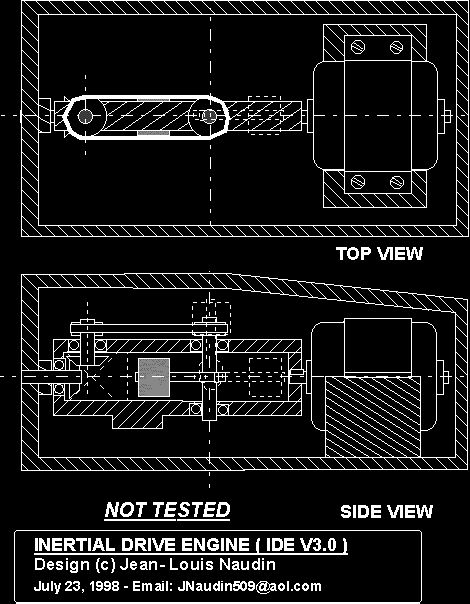
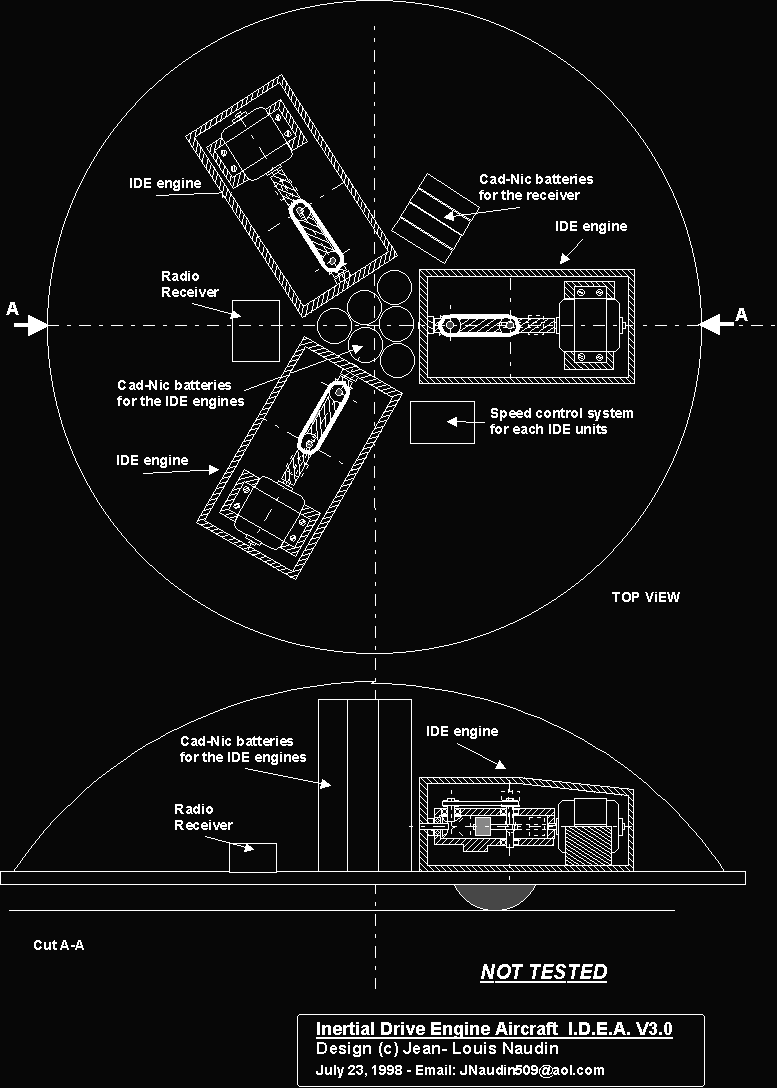
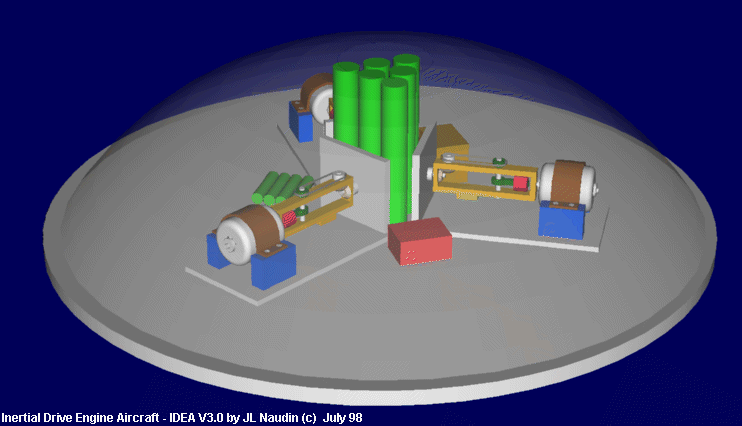
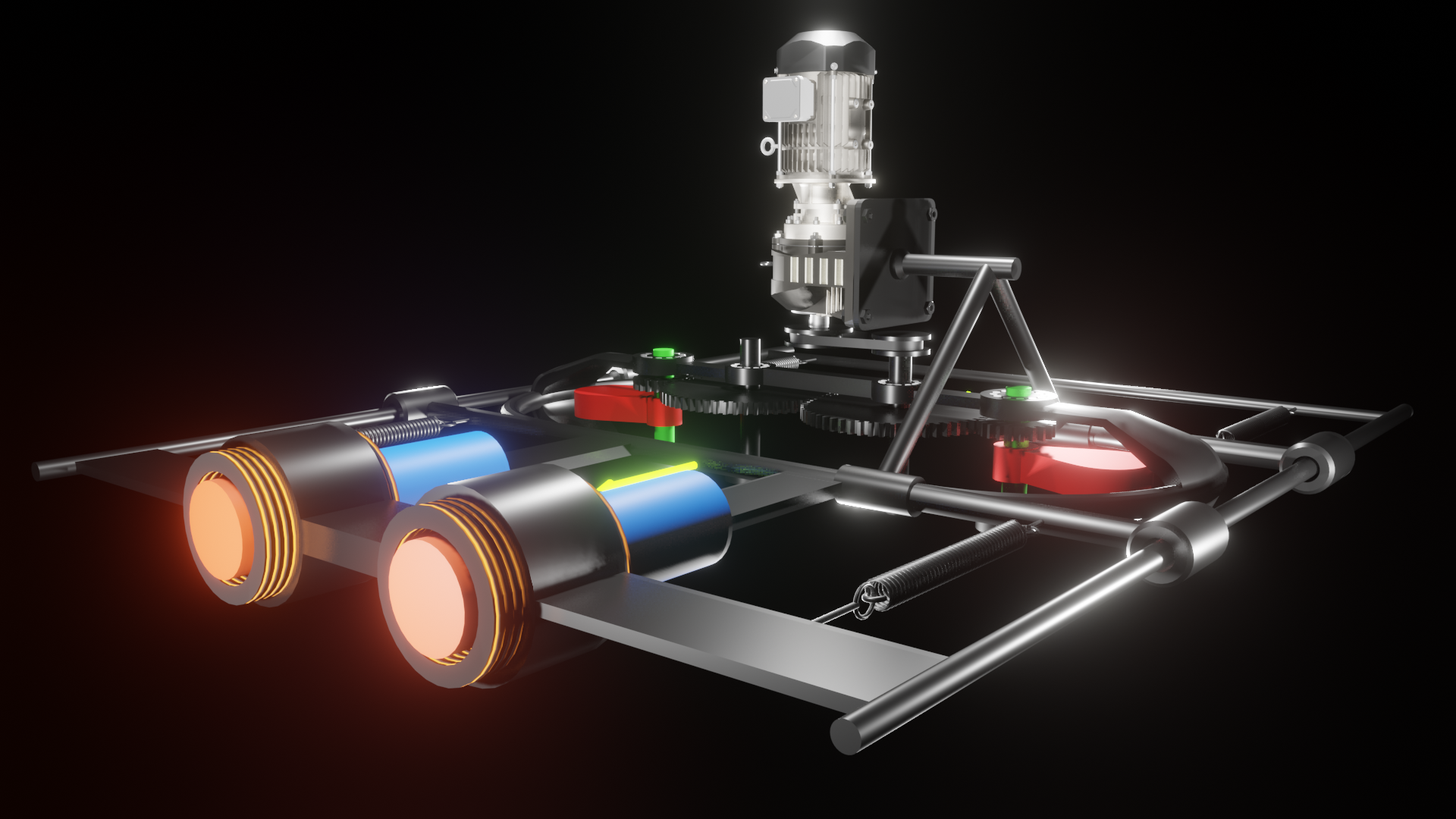
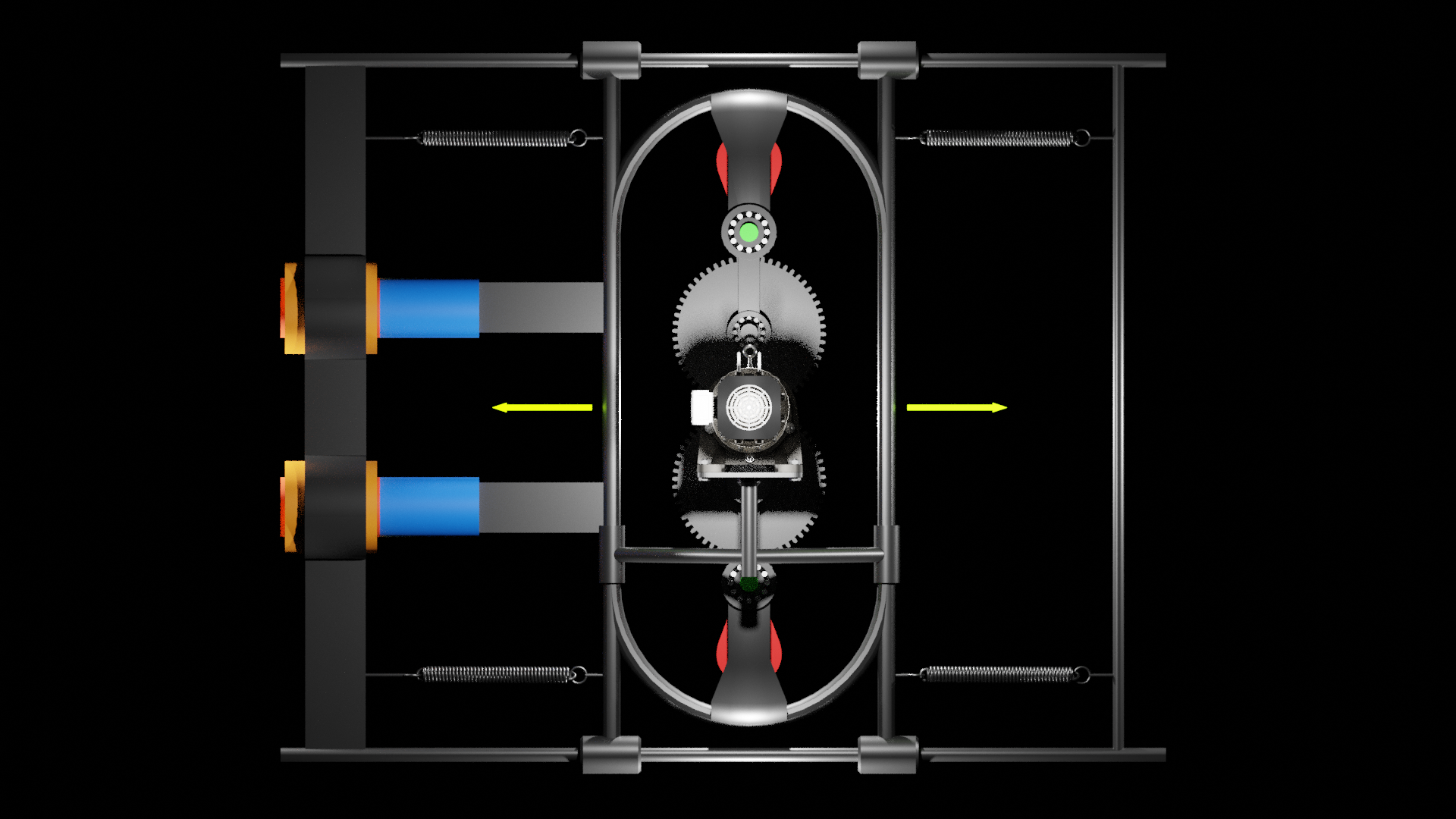
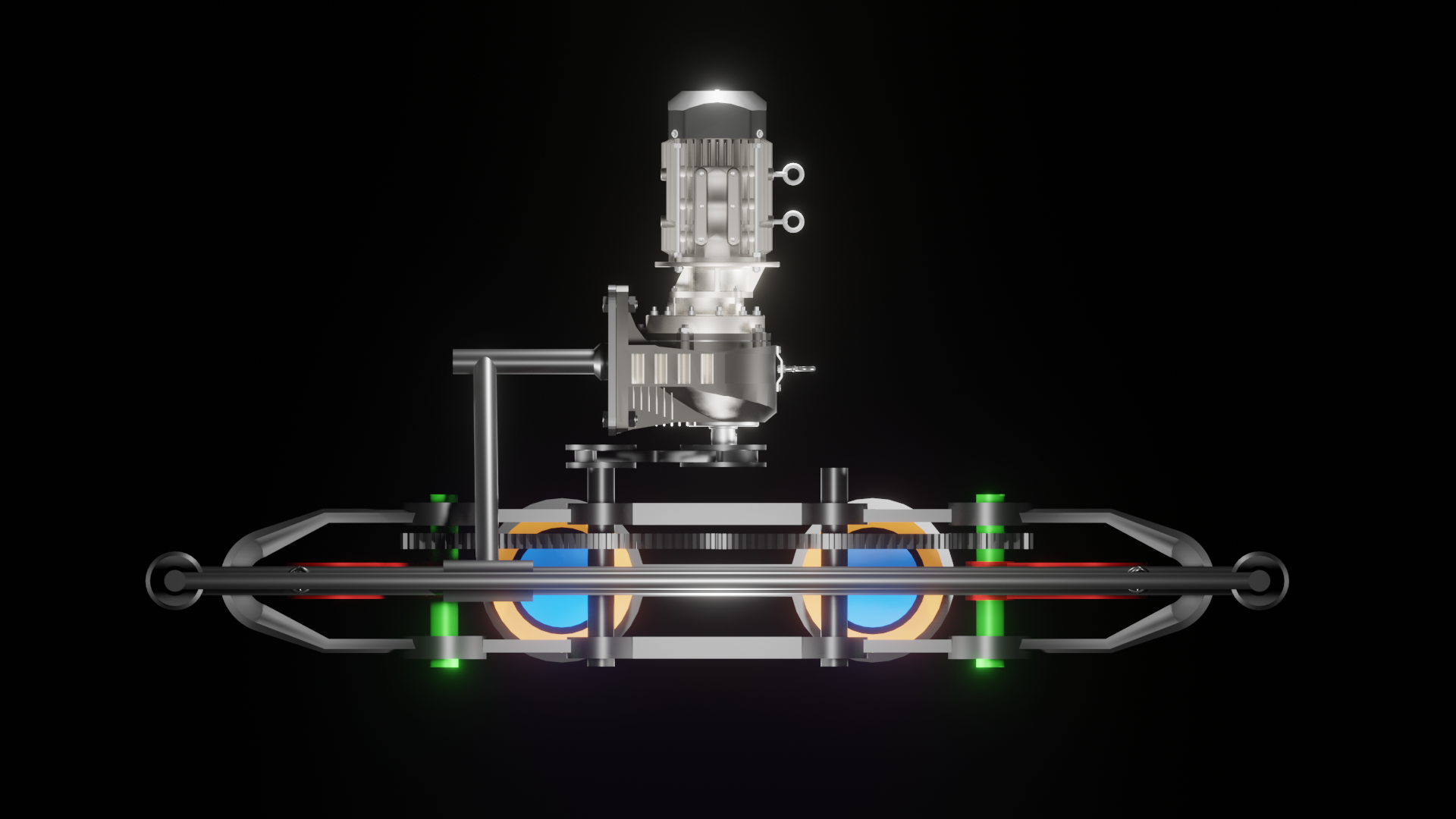
Inertial propulsion using the effect of the crank and mass rotation. Data comes from the JLN Lab website -JLN Lab. Inertial propulsion idea by Jean-Louis Naudin inventor. This isn't new - the device come form yet late 90's. I was considering the same device even earlier without knowing that someone is working on the same topics, but here is some information about this solution. This is not an anti gravity propulsion. The main principle is based on synchronization of rotor and reciprocating mass. Each time the mass is in up hemisphere position the centrifugal force is generated. With the aid of clever gears and transmission belt application, the mass is never in bottom position thus there is no side reaction and the force is not oriented on the circle ( force is never acting in bottom hemisphere), so the up force can acting against the gravity field. Additionally mass is on arm about 20 cm long, so the centrifugal force is much stronger. By the aid of transmission belt the mass and external rotor suspension is synchronized. Entire device is electric motor driven. My investigation bring me to the point that the device should be made with high precision and should have electronic control, because loss of regulation could bring to serious damage of rotor and could be potentially dangerous to person in nearness.
Inertial Propulsion Type 2
2. Cosmic slingshot.
9 September 2020
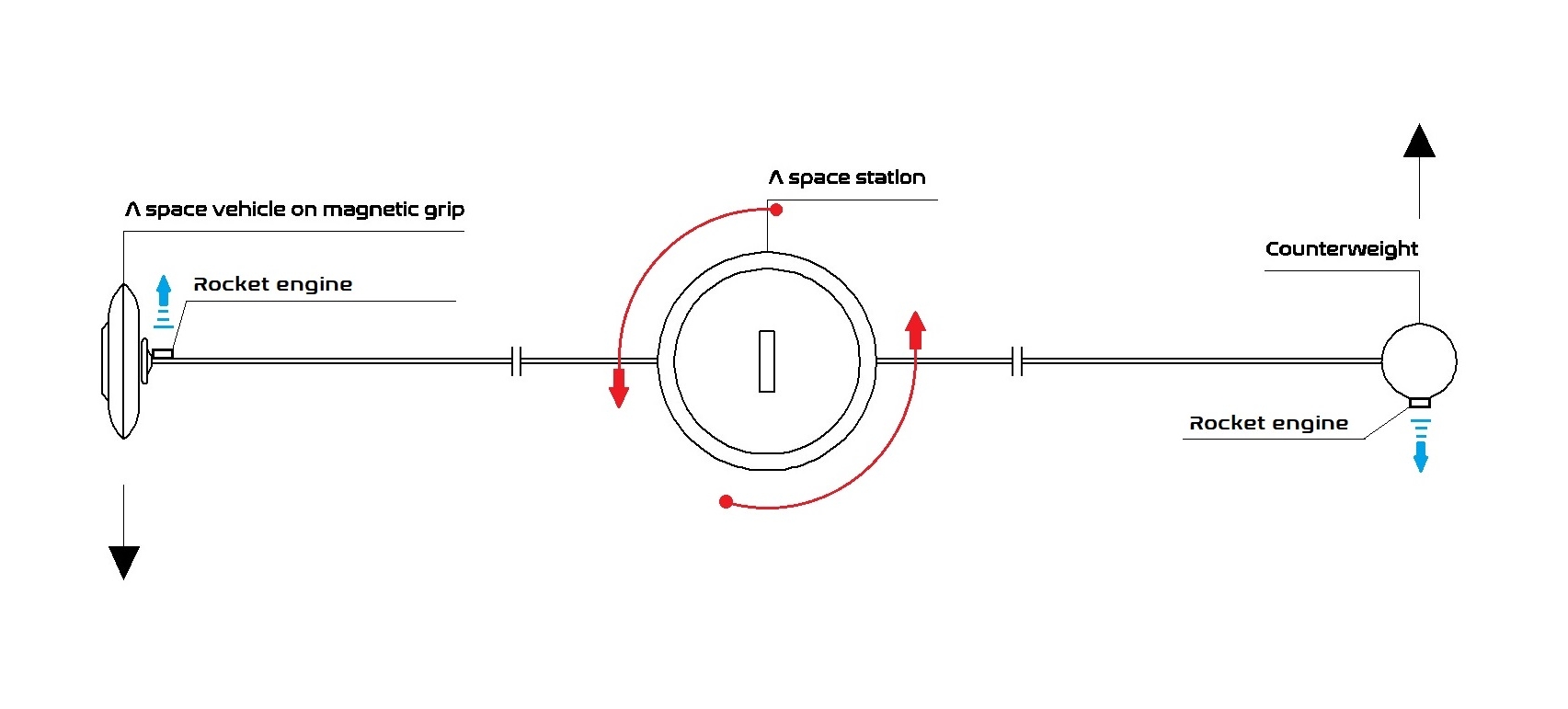
Will a space slingshot ever be realized in space? I've included unfinished drawings with an antimatter and plasma reactor as the launcher's payload. Such a launcher could be placed in Earth orbit and launch cargo and spacecraft toward the Moon after being placed in Earth orbit by conventional rockets or another launch system. Such a launcher system would need to be balanced by a counterweight, identical to the mass of the ship and its magnetic holder. At the center of the launcher system would be a small space station with artificial gravity, used to supply and service the launched ships and to control the counterweight's weight.
3. Enthusiasts and oponents of inertial propulsions
9 September 2020
From ancient times to the time of Newton, people held various concepts of vehicle propulsion that they believed in. After formulating the laws of dynamics, Newton permanently established the course of civilization that humanity can currently take. The famous dictum from the laws of dynamics stating that the center of mass cannot be changed by any internal forces, but only by the application of an external force, is widely held by opponents of inertial propulsion. Therefore, one cannot pull oneself out of a quagmire by pulling one's hair, or by blowing a sail while sitting in a boat with a mast attached to it, which is understandable. The introduction of automobiles eliminated the need for horses and other draft animals, which significantly influenced civilizational development. However, civilizations located on Earth still experience technological deficiencies, visible daily, resulting from the inability to achieve clean technologies and efficient and ecological extraplanetary transport, as well as terrestrial and air transport. Although rockets are now widely used, consistent with the course set by pioneers such as Tsiolkovsky, later Goddard, and so on, this course is still limited to the planet and its vicinity. Furthermore, the speeds achieved using liquid-fueled rockets are mediocre and do not allow for significant distances from the sources of chemicals needed to propel vehicles. According to some, there is no escape from rocket propulsion in the near future, as it is the only viable method of space transportation. Some even argue that propulsion other than rocket propulsion is technically unfeasible, and these are relatively numerous, sufficiently numerous to effectively inhibit the development of other concepts not based on mass ejection. Concepts based on assumptions other than action-reaction methods, as in jet and rocket propulsion, are constantly criticized, and no broad and substantive discussion on this topic has yet been undertaken in scientific circles. On the other hand, the concept of a WARP drive or similar is being considered. However, according to my calculations, the probability of success in designing a WARP drive is even lower compared to an inertial drive. However, the WARP drive concept is more respected because it was developed based on the theory of relativity, which is currently at the forefront in terms of its fundamentals, and no serious researcher would dare to interfere too much with its canons. Inertial drive lacks the same kind of background from such great figures in science as Albert Einstein and is therefore marginalized, despite the fact that some work has been done and certain technological solutions have already been presented with positive results. The materials solutions and their advancement could be similar in both WARP and inertial drives, but the energies required to power both still seem to favor inertial drive. The US Space Agency (NASA), and probably other agencies such as ESA and JAXA, are still experimenting in the privacy of their laboratories with both WARP propulsion and inertial and gyroscopic propulsion, but apparently the investment in such technological solutions remains too limited for them to achieve success, especially in the shadow of rocket technology, which would have to be scrapped if this success were to become reality. It so happens that skeptics of inertial propulsion, as of now, have financial backing and are supported by technology lobbies worldwide and possess enormous capital. While proponents of this propulsion are limited to a handful of people, without any scientific basis for support. Frankly, they have little influence on the current technological course prevailing worldwide, and this situation is unlikely to change anytime soon. However, if it were to change, it would only be in the event of an urgent need, such as evacuation from Earth, due to natural disasters originating from space or due to human activity itself. This could change the situation, where the need of the moment would be more powerful than any lobby, and in a situation where the threat of the current technological deal falling apart would be significant. Other situations are unlikely to be an option, as the political, economic, and social psychology systems reject the rapid off-planet development that some unconventional propulsion system could provide. Society is not yet ready for this, despite the development of a philosophy of off-planet exploration. In reality, this may merely be a course aimed at maintaining the existing distribution of power in the world, disregarding essential social interests. Society in this system is relegated to the background, and the beneficiary of the system is not the society itself, but the interests of the wealthiest 1 percent, who control over 75 percent of global capital. For them, any change that eliminates their influence in the world is a threat to them, and they have no interest in its occurrence. One concept that challenges the notion of the impossibility of shifting the center of mass using forces originating from within the system is the simple concept of a rotating eccentric. Statically, the concept of a stationary center of mass, independent of internal forces, may be valid, but when dynamic forces resulting from the rotation of masses come into play, the situation can change. The thesis, postulated by some regarding centrifugal forces, that they are a force that doesn't actually exist contradicts phenomena observed in the natural environment. Whether this force is illusory or not is irrelevant, as it affects matter, similarly to gravity or magnetism, and that's precisely what matters. Its influence should be maximized by technology for general purposes, including the construction of vehicles and the creation of artificial gravity on space stations. At the atomic scale, this force enables the fundamental particles of matter to function at all, as it acts on electrons, keeping them in their orbits when interacting with the electric forces resulting from elementary charges. For now, however, skeptics of inertial propulsion outnumber its proponents, largely due to school teaching, where concepts not based on Newtonian laws are not even considered. In fact, proponents of this type of drive are treated with a smile of pity, doomed from the start with their absurd inventive concepts. None of them has yet demonstrated sufficient potential to change this situation, and these concepts have been forgotten or are currently in retreat. There's little media coverage of issues at the fringes of science, unless the data is developed by companies with significant global technological presences. And when they are mentioned, it's with little relevance to the overall technological landscape and negligible impact, which, in my opinion, is regrettable. Such monotony negatively impacts the development of young minds, creating successive batches of programmed scientists, lacking vision, simplified to fit the technological mainstream. Inertial propulsion doesn't contradict the theory of relativity, but it does contradict Newton's three laws of motion. However, it must be considered that Newton's work was verified by Einstein's theory of relativity, and this represents a different approach to the same topic. In my humble opinion, Einstein ignored the problem of quantum gravity, which is the source of inertia, because using analytical methods based on mathematics, it is impossible to solve this type of problem, not at this stage of knowledge. Some phenomena in nature cannot be described by mathematical equations, because to find solutions to them would not be enough time for our universe to exist. The fate of Earth depends on changes in its fundamentals, not on a fixed technological course that is leading our world towards destruction. If it were otherwise, economic problems would subside, wealth disparities would disappear, we would breathe fresh air, and humanity would no longer be prisoners of our own planet. What is happening in the world today is a lack of respect for the planet and a lack of respect for life itself. Horrific scenes are unfolding, and in my opinion, our civilization has no more than 50 to 80 years of existence before anything can be salvaged. If significant changes are not made within that time, its fate will be sealed.
4.Norman Lorimer Dean inertial propulsion
9 September 2020
Throughout the 20th century, various designers have presented interesting propulsion solutions. Some, like Norman Lorimer Dean's (1902-1972) drive, remain incomprehensible and unexplained to some people to this day, and news of them is currently unpopular, omitted from scientific lectures, and considered unworthy of attention. Dean's drive represents precisely this type of drive, which, like many other inertial drive systems, seriously challenges Newton's third law of motion, hence, as one might expect, is dismissed by standard science as a technological marginalization. Newton is famous for creating a formula for gravity, but this formula only defines certain physical relations and relationships, does not provide insight into the nature of gravity and reveals little about it in itself. Newton's laws of motion, on the other hand, provide a sparse account of simple force systems, without extensive qualitative analysis. It's telling that the belief in Newton's laws of motion, so far, largely boils down to the fact that humanity, as a whole, continues to race toward a technological dead end, using rocket and jet propulsion. Thus, polluting our own atmosphere and the planet's vicinity, we move like a dog chasing its own tail?not allowing ourselves to gain freedom, because we imposed a certain pattern on ourselves from the very beginning. I wouldn't glorify with such absolute and unconditional trust everything created by Isaac Newton or Albert Einstein, because they were only human and unable to predict where they might have gone wrong. Even if their mathematical calculations confirmed their main hypotheses, a simple error could have led them to false beliefs. And their work certainly shouldn't be treated as the sole defining form of technology for that civilization, because technology was viewed differently then than it is today. There were different stages, different opponents and fanatics, each could have been right or wrong, and history unfolded as it did. Because every rule has exceptions, which these scientists were unable to predict from their perspective. The technology created by this civilization may never reach its full potential if it relies on laws created hundreds of years ago in a situation of limited perception, which is still imperfect today. Humans will constantly acquire knowledge, and there will be no shortage of it, as long as they continue to learn. The Dean Drive utilizes centrifugal forces, synchronized moving eccentrics, and a solenoid. I've posted a YouTube video explaining the operation of the Dean Drive. This inventor's drive shatters scientific canons, and if implemented successfully, it would have the potential, like many other inertial drives, to completely transform the modes of transportation used by our civilization. The invention occurred in the 1950s, but Dean died in 1972. From the time of its invention until his death, his idea did not see significant dissemination. Dean's idea was to convert the inertial energy resulting from the movement of the oscillating eccentrics into mechanical energy using a magnetic field from a solenoid, which was to be switched on when a rod passed inside it, this rod was pushed by the oscillation of the eccentrics, which oscillated once in one direction and then in the other, because they were synchronized and therefore gave a reaction only in two directions, and not in all as in a conventional eccentric. Dean exploited this phenomenon to convert the system's energy by half through magnetic conversion into a recoilless and reactionless propulsion system. Even today, this would be considered a curiosity, as evidenced by the current scientific reluctance to accept inertial and inertial propulsion systems. If Dean's propulsion system had been developed and operated at a higher frequency and on a sufficient scale, its results could have been magnified and its parameters improved, but no one undertook further work. In the 1970s, To³czyn and later Robert Cook were active, and in the present, G. Szypov and others, less well-known, are also active. However, there remains a lack of significant interest in these propulsions from the right people who possess the technical and financial resources. This is worrying, because the prospects offered by the rationalization of inertial propulsion systems may exceed simple imagination and prediction. This prompts many people today to work even harder to finally see the light of day, even though they lack significant economic power or particularly advanced resources. The Dean Drive is a simple inertial drive and, at its current stage of development, provides only a small amount of propulsion. There are drives of this type with much better parameters. Many of these drives have enormous development potential, but there are currently no investors willing to invest. Newton and the faith of current scientists in him are exceptionally strong, to the point that, in the name of defending his principles, they are willing to reject certain events and devices that should normally prompt a redefinition of certain attitudes and views. They cannot be denied, as they actually happened, and some of them witnessed these events firsthand, yet they disbelieved them or rejected their technological foundations due to their lack of complementarity with current technological developments. Centrifugal force is a free force and, like the Lorentz force, can be converted into a propulsion system operating in space if the appropriate design solution is implemented. In the case of centrifugal force acting on eccentrics, as in the Dean drive, this force does not repel either the ground or the unemitting gas or liquid stream, because this force is merely the result of the action of two coupled, rotating, eccentrically approved masses. If, as has been speculated, friction had already interacted with the ground, the whole thing would not have acted in every direction, nor upwards against gravity. As has been found in numerous tests during the operation of Dean's devices, the total force exerted on the scale decreased, even though the mass remained constant. The weight exerted by the devices decreased, even though the gravity gradient remained the same. Newton's third law of motion applies only to the specific situation in which we are dealing with forces acting on a system of two bodies, and this definition should not be applied to everything technologically possible. Every action is accompanied by a reaction, equal in magnitude and direction but opposite in direction. However, this is not always and not everywhere. While it is a law that applies throughout the universe and is universal in nature, it does not always and not everywhere apply, and it is not fundamental when it comes to certain solutions in mechanics, where we are dealing with closed systems of force transmission and fluid dynamics. In complex technological systems, this law simply fails, and this also happens in the case of devices based on the inertia of matter. This is because Newton was guided primarily by observation of nature, where he had no insight into deeper physics nor was he exposed to any technology that, if he were alive today, could have influenced the definition of his laws, which would have allowed him to formulate them differently. Centrifugal force does not repel any medium, does not require any medium, and functions best in the vacuum of space. The nature of centrifugal force is unknown; it likely relates to the intraatomic structure of matter. Like gravity itself, it results from interactions between elementary particles and within the atomic nucleus, which we don't yet know about and may be electromagnetic in nature. Both centrifugal and gravitational forces correlate with all interactions, including those with photons, charge carriers, and mass carriers.