6 June 2018
1. Electromagnetic propulsion
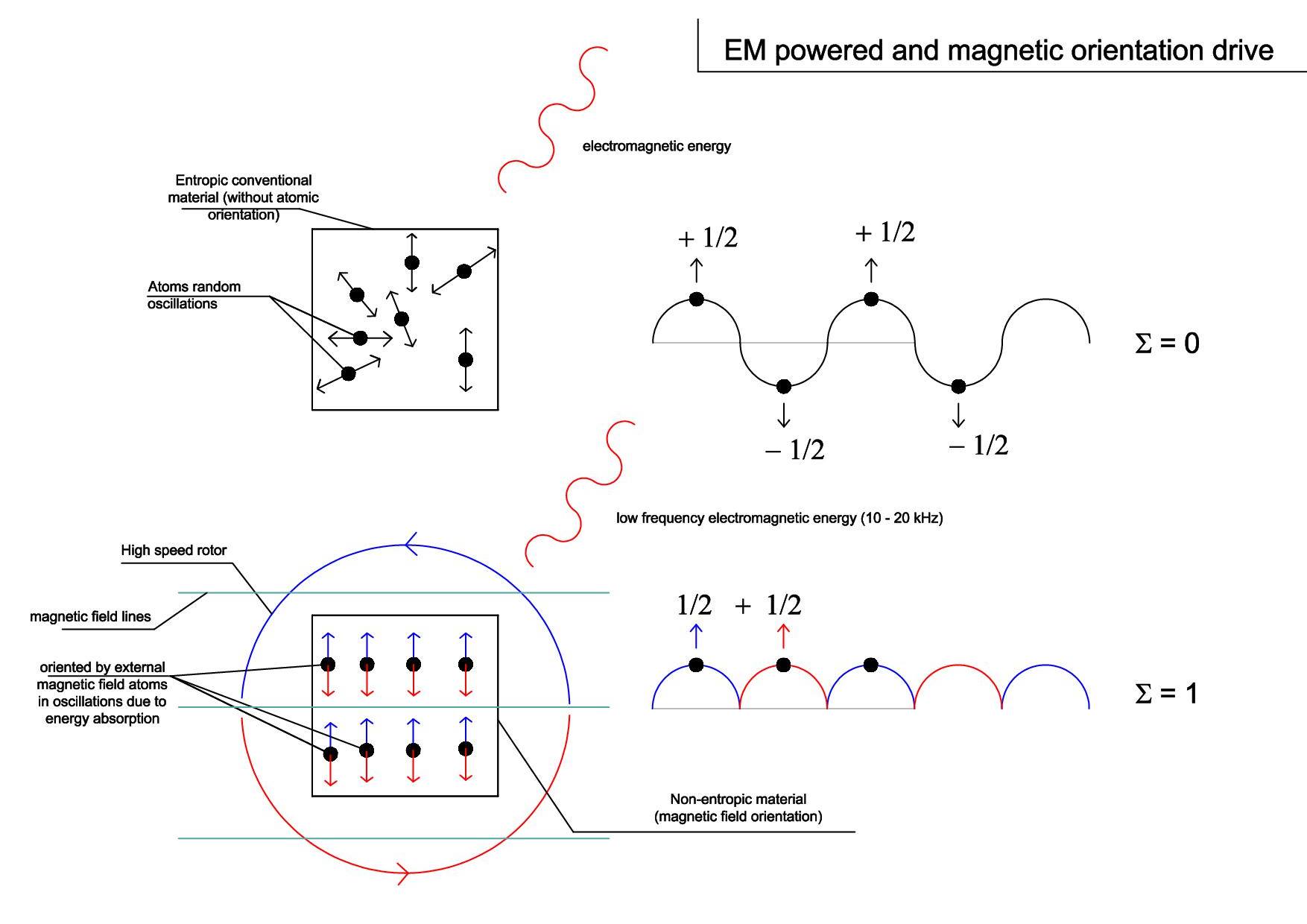
Electromagnetic propulsion is a drive in which the driving force is electromagnetic energy. As we know, electromagnetic energy is a localized disturbance in spacetime propagating at a speed of approximately three hundred thousand kilometers per second and relies on the interplay of magnetic energy and an electric field. However, an electromagnetic field alone is incapable of propulsion for material objects due to its lack of mass, and therefore, conventionally, it is unsuitable for generating thrust in action-reaction mechanisms. However, it does possess angular momentum and can thus exert pressure on an object, which is evident in the operation of devices such as mills that utilize electromagnetic wave pressure. However, perhaps a different approach to electromagnetic waves should be considered in this context and a different way of applying electromagnetic energy to vehicle propulsion. We know that electromagnetic energy has a significant impact on matter, including its ability to determine the state of matter and its density. Its interaction with atoms leads to their increased acceleration within the medium by influencing its temperature. Temperature results directly from the average kinetic energy of atoms in a given medium, up to the ionization energy, where matter becomes plasma due to electron loss. We have long been able to utilize the effects of heating media like water or gases for our own purposes, primarily involving the transformation of electromagnetic energy into vapor pressure energy and then electrical energy. However, all these techniques are relatively primitive forms of obtaining energy itself, specifically its conversion into electrical current, and the basic energy in this system comes from fossil fuels or the radioactive decay of uranium. To look at electromagnetic energy differently and address its fundamental mechanism of transformation of the external energy of a photon quantum into the kinetic energy of an atom, we would have to generalize this mechanism from the atomic scale to the scale of human life and its functionality, i.e., the macro scale. The development of a single atom?even the simplest hydrogen atom?in its single-proton form without additional neutrons into an entire spacecraft, where constant electromagnetic energy would be supplied and, through this atomic mechanism, converted into thrust. It's difficult to say how possible this would be. However, there are certain mechanisms in nature where electromagnetic energy seems to be stored, only to later emerge in an explosion, as in the case of superheated water and explosive boiling. Therefore, it would be necessary to study this type of behavior of material media and explain it from a quantum and functional perspective. Electromagnetic energy can induce resonance in matter, as a result of which electrons can flip to their opposite positions, as in electron paramagnetic resonance. In electron paramagnetic resonance, the existence of a constant magnetic field, a paramagnetic substance such as copper, aluminum, or silver?substances with a non-zero atomic magnetic moment?and the proper frequency of the electromagnetic field are crucial. As a result of this resonance, electromagnetic energy is absorbed by electrons from electron shells. These electrons react by flipping their orbital axes by 180 degrees, i.e., turning upside down. Another type of magnetic resonance involves the emission of a radio wave from an atomic nucleus in a constant strong magnetic field when disturbed by a weak magnetic field. This is nuclear magnetic resonance, a phenomenon that is already widely used in medicine to study the tissues inside the body. Paramagnetic resonance is commonly used in chemistry to detect, for example, defects in dielectrics, study free radicals, ions, and atoms of substances with unpaired valence electrons, where resonance occurs at a magnetic field strength of 0.3 T and a frequency of 10 GHz, this is the so-called X band. It should be checked whether this resonance does not also occur at higher frequencies, e.g., infrared and thermal frequencies, i.e., at frequencies from 300 GHz to 400 THz, paying particular attention to the phenomena of electromagnetic energy absorption without dynamic effects inherent to this process and dynamic transformations occurring immediately after these transformations, without and with the presence of a magnetic field, because a magnetic field can affect substances with unevenly distributed charges inside atoms and molecules, where internal entropy does not lead to differentiation of the symmetry axes of these substances, which can perhaps be used to control detonation and electromagnetic relaxation processes in these substances. Specifically, if electric dipoles could be oriented in a specific way, directed motion could be achieved, a drive during this internal relaxation independent of the material's internal entropy. Einstein-Bose condensates are concentrations of particles, such as rubidium atoms, at low temperatures, that exist in identical quantum states. Obtaining them requires special techniques, primarily involving separation by magnets and lasers, to prevent them from losing quantum synchronization, which primarily involves synchronizing their momenta. This phenomenon is the coordination of atomic momenta and is, in fact, the fourth type of matter concentration, besides gases, liquids, and solids, not counting plasmas, that has been successfully obtained in the laboratory. However, even earlier, I became interested in a slightly different phenomenon, involving the accumulation of thermal (electromagnetic) energy during the heating of certain substances, such as pure water, under conditions in which the substance cannot release the supplied energy, for example, during evaporation (due to smooth vessel walls, slow heating, or microwave heating). In particular, the quantum mechanism responsible for these types of reactions can be interesting for many reasons. I'll write a few words about this interesting phenomenon here and now, although I realize it's an unexpected topic, perhaps less visible to science, and unusual for my blog. Under normal conditions, when a substance is heated, electromagnetic energy in the form of photons, if we consider the state of matter of all objects, is absorbed proportionally to the resulting reaction, i.e., expansion (increasing the volume of a gas; the same phenomenon applies to liquids and solids) as a result of heating. The average kinetic energy of the particles increases because the particles are accelerated by absorbing photons from the thermal field. This process most likely occurs when photons collide with the valence electron shell, the outermost part of the atom, and are specifically absorbed by a specific electron. If this electron is struck by a photon, a "packet of electromagnetic energy," it accelerates in orbit and is able to leave it. Consequently, due to its mass and, above all, its electric charge, it will inertially pull the entire atom with it, coupled to that electron through its opposite charge. Or, if the supplied energy is sufficient or exceeds the ionization energy of the first electron, the electron will detach from the valence shell of the atom, and the atom will become a positive ion. I don't need to explain this further, as it is basic knowledge. However, there are phenomena known from the chemistry laboratory, such as exceeding the boiling point of a liquid, without the effects typical of such processes. I also realize that ionization energy is significantly higher than that of boiling water, but this is only a comparison intended to develop a foundational understanding of this phenomenon. The quantum-level mechanism responsible for this type of fluid behavior may prove diverse and very interesting, primarily because it is not understood by science, which may confirm this assumption. I once accidentally contacted and discussed this phenomenon with renowned theoretical physicist Arkadiusz Jadczyk. Unfortunately, he was unable to answer questions about the quantum basis of the phenomenon and was unable to even partially explain this type of molecular behavior within the framework of modern theoretical physics. I tried to understand the essence of this mechanism myself, but I am not a physicist, nor even a scientist, and my work so far has been tedious CAD design. Partly for this purpose, however, I built a small laboratory that would allow me to explain these and many other issues. However, it is still in the equipment phase, precluding the possibility of conducting the required experiments. Frankly, I don't know how to approach this task even once the laboratory is ready. I suspect that so-called hydrogen bridges may play a significant indirect role here, as the water molecule is electrically polarized, meaning that the chemical bond does not completely and uniformly bind the electric charges of hydrogen and oxygen in the water molecule. Therefore, like many other substances, water is also subject to external fields such as magnetic fields or electric fields, because it possesses a magnetic moment. As a result, water's cohesion significantly increases, which directly affects its properties, in particular, its boiling point. This led me to the discovery of this cohesion, which prevents water from boiling even at temperatures of 110 Celsius degree or higher, as it is also conditioned by hydrogen bridges. A situation involving relaxation and resonance processes within the substance's particles could also arise, which I am also considering. The available literature offers virtually no precise and unambiguous explanation for the process of liquid overheating beyond its boiling point from a quantum perspective. Much less an explanation of how the rapid conversion of electromagnetic energy into a mechanical reaction occurs, nor the mechanism for storing energy until it is converted into mechanical energy, which could be crucial for appropriate techniques. On the other hand, this phenomenon has a second facet and is dangerous, for example, in boiler installations, as it can even lead to the rupture of the heating device or its serious damage, similar to cavitation effects in such systems. Explaining this problem could have interesting implications and consequences. Firstly, knowledge of this topic could enable the development of technologies for accumulating electromagnetic energy to build propulsion and power certain devices and vehicles based on similar quantum mechanisms. Secondly, understanding the quantum mechanisms of these phenomena would enable, assuming the use of quantum constant state technology (as in the case of Einstein-Bose condensates), the use of electromagnetic energy that, in the long term, would enable the implementation of electromagnetic propulsion with capabilities unheard of in current technology, which can currently be attributed to technologies developed by advanced intelligences of the type possessed by extraterrestrial civilizations. That's all about laboratory work. Yet another interesting phenomenon is the crystal transformation phenomenon occurring in certain metal alloys, such as the nickel-titanium alloy, which possesses so-called shape memory, which is similar to the phenomenon described for liquids. However, here we are dealing with a metal and its crystal lattice. Here, energy is, as it were, stored within the alloy's crystal lattice and released as a result of, for example, immersing the alloy in boiling water. All the phenomena described here may have, in some sense, similar quantum foundations. By consistently developing these technologies, it would be possible to achieve highly advanced drives that would be more than just marginal applications in our environment. Another issue is the ability to slow down the propagation of fields (primarily magnetic) by inertial fields and the associated effects (described in some inventions, such as the N-machine and others, which are so efficient that they generate enough energy to maintain their operation without external energy for an indefinite period of time. They are examples of "perpetual motion" devices, and once set in motion, they can theoretically continue operating until their components wear out mechanically, operating using, for example, the interaction of an inertial field within a magnetic field via an inertial field, a torsion field, etc.). The N-Machine device has an additional rotating disc in which additional current is induced. In terms of operation, it does not differ from a standard generator, but the energy coming from the additional rotating disc causes the device to be over-efficient, which allows it to be called a free-energy device. However, there is no data on how the device would operate under the load of electrical receivers. In the case of the N-machine (constructed by inventor Bruce De Palma), a method was used to slow down the magnetic field in specific media or counteract its propagation with another field or force, such as centrifugal force or a torsion field. As we know, such phenomena have not yet been experimentally supported, but if it were possible to significantly slow the propagation of the magnetic field, for example, to 1/10th of a centigrade, it would become possible to apply certain technologies that until now had only been presented on sheets of paper as sterile projects, as technology still prevented their implementation due to a lack of appropriate field control options. One can only speculate how this would work, but it would certainly be a completely different quality, one upon which physics, or at least some of its fields, could be built from scratch. A crucial issue is the degree to which the magnetic field influences the gravitational field, as centrifugal force is, after all, a quasi-gravitational force. These relationships likely constitute the very essence of the problem when considering transportation technology on a broader scale, as well as medicine (nuclear magnetic resonance and other phenomena involving magnetic fields), and at the same time, the most interesting part (at least for me) when it comes to field physics and the properties of matter in contemporary theoretical physics. From the perspective of quantum mechanics and particles, a magnetic field lacks its own particle?an energy packet that would transmit its properties, understandable within today's canons of knowledge. Similarly, the existence of the graviton has not yet been experimentally confirmed. Current knowledge does not provide clear answers to all questions about gravitational interactions, the nature of weak interactions in general, especially at the atomic scale, or the field mechanism causing mutual gravitational attraction. Therefore, existing theory does not allow for practical control over gravitational processes in terms of specific technical applications, as public interest in these matters is low, almost nonexistent.
Symmetry plays a crucial role in a world composed of matter. It determines the course of certain processes, both on a micro and macro scale, and significantly influences the behavior of matter, its properties, and its organization. In nature, many features based on symmetry concern the structure of living organisms and the spatial composition of components of the natural environment. It is hypothesized that at the dawn of the universe, immediately after the Big Bang, matter and antimatter arose in parallel and symmetrically, in nearly equal amounts, leading to their immediate annihilation. However, this remaining fraction constitutes the universe we know today, including all galaxies and stars. Something led to the breaking of symmetry, preventing the complete destruction of the material component of the cosmos. It is also known that in nature, pairs of antimatter and matter are constantly being created. Even in a vacuum, spatial fluctuations occur, causing their appearance. However, this occurs in such a way that these particles do not fully materialize, as they annihilate before they acquire mass. According to the law of symmetry of phenomena in space, one can conclude that each of these processes, phenomena in our environment and in the distant universe, should have its opposite in the form of inverse properties and correlations with matter and space-time. In most cases, this is indeed the case. For example, there is a duality of matter, encountered ubiquitously in everyday life, which is difficult to miss. Such relationships demonstrate the bipolarity of natural laws. In commonly used technology, principles exist, as in electrical engineering and electronics, such as the relationship defined by the absence of current flow, which is represented by zero in mathematical notation, and on the other hand, the existence of a state of current flow, defined as one. This makes information recording and processing meaningful not only in computer science but in all related fields. Almost all wireless data transmission methods rely on an electromagnetic wave, which is nothing more than a set of propagating ripples, opposite in time to each other, oscillating between amplitude phases. Others rely on frequency modulation. However, current knowledge does not allow for many manifestations, reversals of phenomena that could intuitively occur if this type of symmetry law were considered consistently. What is most interesting is the question of whether current knowledge of physics in our temporal continuum is complete enough to exclude certain phenomena that could theoretically exist if the symmetry law were taken seriously. It must be acknowledged that some manifestations of their presence would undoubtedly have the potential to open up entirely new technical possibilities and even enable a broader redefinition of the knowledge of physics.