Force fields.
As space exploration evolves into a multifaceted human conquest of space, the need will arise to build force field generators to protect spacecraft from space debris along their flight path, as well as valuable strategic assets in space. The idea of force field dates back to ancient times in science and technology. This concept has occupied the minds of inventors such as Nikola Tesla and theoretical physicists such as Paul Dirac and Albert Einstein.
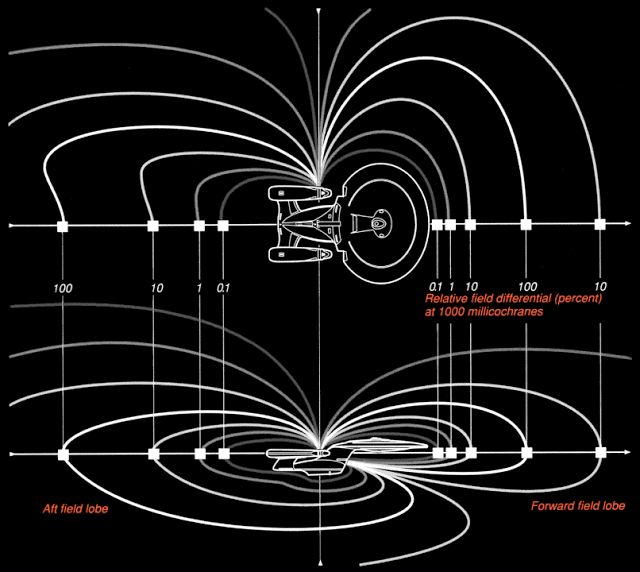
Whenever we speak of a force field as such, its essence still seems to elude the understanding of today's researchers. A force field, by its very nature, must meet certain assumptions, it must act on all material objects. That is, it must be a field of gravitational or quasi-gravitational nature. In this case, it borders on the physics of as yet unknown fields related to the gravitational field or even with completely unknown physical properties. Modern physics is still incomplete, and the fact that some believed that the theory of relativity made it complete does not confirm the validity of this assumption, because those researchers who postulated this were mistaken. Various researchers in the past, including T.T. Brown, who have been overlooked by scientific canons until today, often found the right paths to force fields. However, their achievements failed to translate into a global situation, and today we continue to rely on the risks that also apply to the ISS and other infrastructure in space, which are at risk of colliding with space and orbital debris, because they remain unprotected by any field, not just force fields. The crews of our vehicles and space stations are still exposed to harmful cosmic and solar radiation, a drawback we have not yet been able to satisfactorily eliminate. Therefore, the risk of radiation exposure can and should discourage further space travel. We are still far from solving the technical problems of safe space flight. No human has yet left the vicinity of the planet, no one has traveled further than 1 million km from it, and the distance from the Earth to the Sun is approximately 150 million km. This demonstrates how little we have achieved in terms of manned spaceflight. The distance from Earth to the Alpha Centauri system is approximately 40 trillion km, and light takes 4.22 years to travel this distance?the speed of light is negligible considering the scale of the universe. At high speeds, fragments of matter found almost everywhere in space can damage any spacecraft unless it possesses a force field. Therefore, it is crucial for the safety of these vehicles' crews to have such a field. This field should prevent space debris from contacting the spacecraft's hull, using a reverse-polarity gravitational field or another strong field that must surround the vehicle on all sides, preventing the accelerated particles from penetrating the hull, which could then result in depressurization and, consequently, suffocation of the crew.
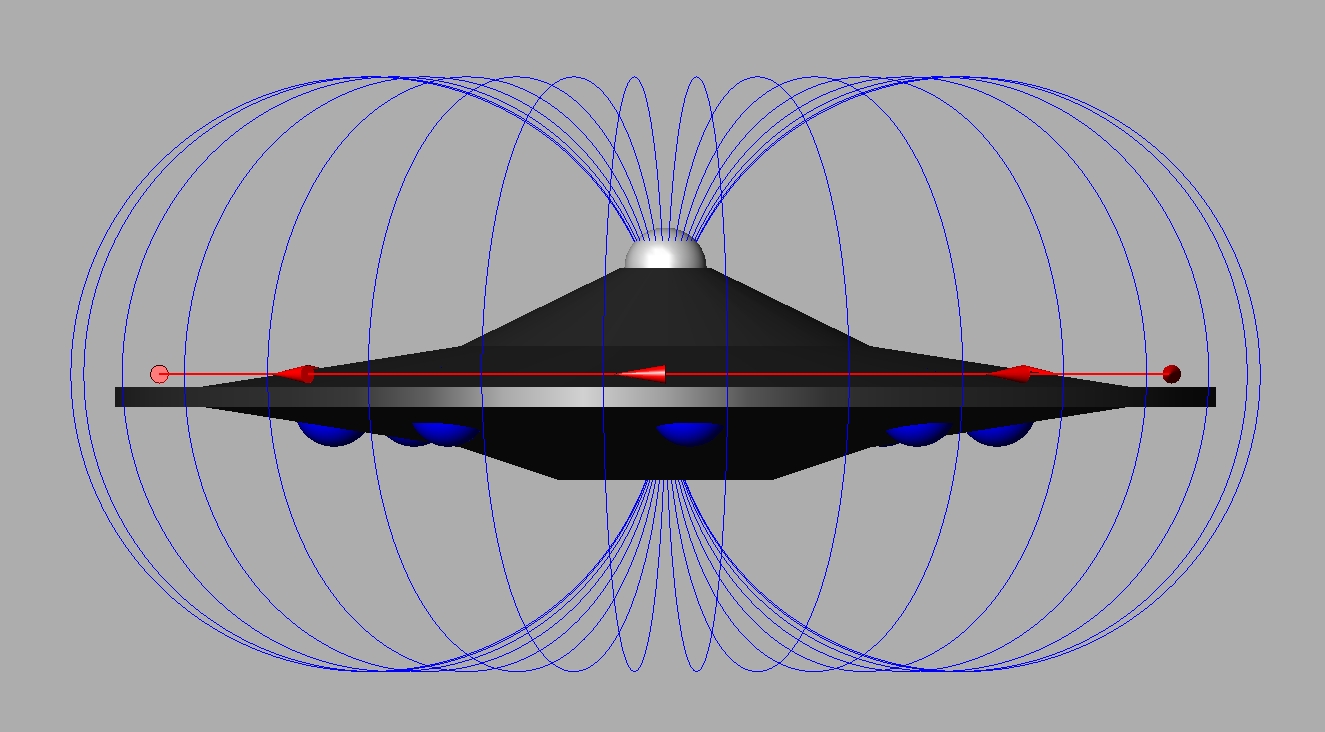
However, it is difficult to create even the basics of this type of field, let alone implement any technical solutions, without adequate knowledge. Matter is permeated by a gravitational field, and this field is entangled with itself through its own quantum state. This is inherent to every material object regardless of its location in space. Each object has, as it were, its own gravitational imprint. Therefore, technology enabling a force field should ideally be able to act on the entanglement effect itself. If we could influence the effect of entanglement with the gravitational field, we would have control over the gravitational properties of material objects. Another method could involve a high-energy, high-frequency variable magnetic field. A variable magnetic field might not only propel an object into space but also slow it down and immobilize it so that it can bypass the volume of a spacecraft. However, although this type of technology would work on ferromagnetic and paramagnetic objects, it would be more difficult to achieve a protective field for objects characterized by diamagnetism with a zero magnetic moment, but this would perhaps be a matter of appropriate sophistication of this type of technology. The history of attempts to invent space propulsion systems, not only conventional ones but also those that violate the basic assumptions of the theory of relativity or cleverly circumvent them, is replete with various concepts that have been "frozen" indefinitely in the freezer of science and technology for many reasons. Some of them must wait until materials science and solid-state physics open the door to their implementation, while others must wait until physics unlocks new, distinct technological realities, such as entirely new fields that current science cannot yet predict. It is possible that certain variations of energy fields, such as the coupling of electric or electrostatic fields with gravity, or magnetic fields with gravity, will lead to such a revolution in transportation in the future that, from today's perspective, no one can predict the possible developments. The work done earlier by some marginal researchers, concerning phenomena on the borderline of even current science and technology, gives us to understand that modern physics is full of inaccuracies and imperfections, and the gaps in its structure will in the future often be the gaps that will turn into quite fantastic technological possibilities.