9 September 2020
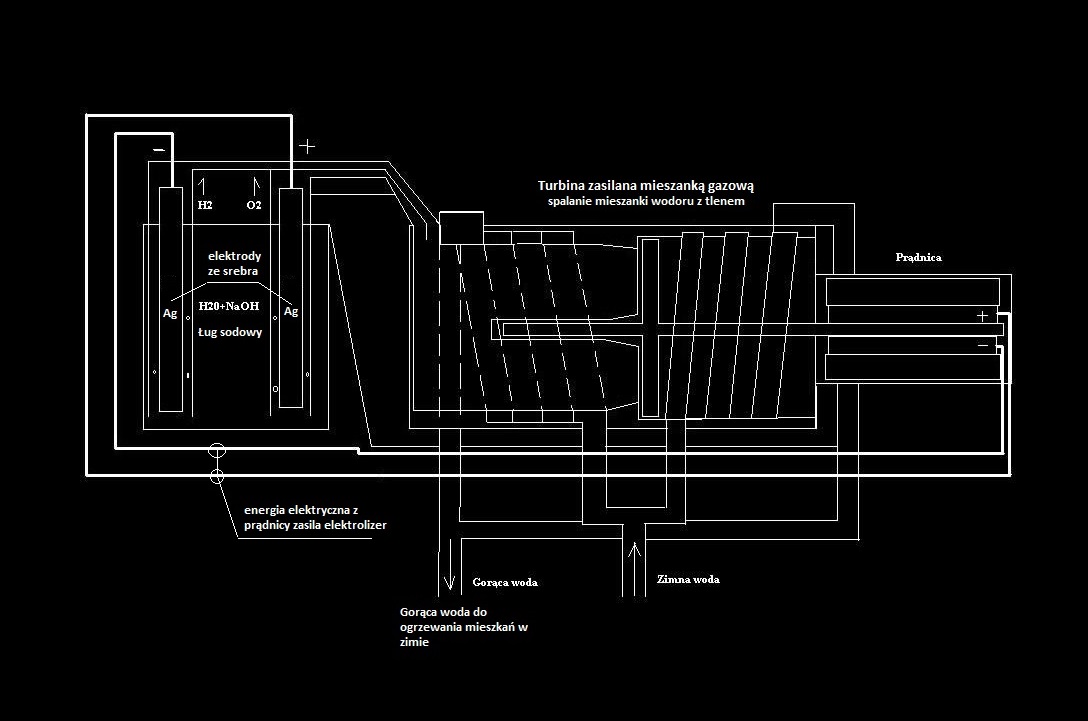
Hydrogen can be produced using quite simple household methods, for example, by reacting aluminum with sodium hydroxide solution (a drain cleaner). Water electrolysis also produces oxygen and hydrogen, and the electrolysis of acids and other substances produces large quantities of this gas, which can then be used as fuel in various energy and heating systems, such as combustion cells or combustion engines powered by liquid hydrogen. Hydrogen burns cleanly as a fuel; under certain conditions, the product of its combustion is usually simply water. Hydrogen is the simplest element in terms of atomic structure and the lightest on Earth. Hydrogen reacts chemically with many other elements and plays a crucial role in nature, it is a component of organic substances, which constitute the building blocks of living organisms, including humans. Without hydrogen, there would be not only no water, but almost no processes could take place in space, which is rich in stars, and for these stars, hydrogen itself is the fuel in its ionized form, i.e. plasma. Under the planetary conditions prevailing on Earth's surface, this element is used in the human economy in many ways. However, it remains underappreciated as a fuel, where hydrocarbons continue to play an even more important role. Hydrogen can be used to heat cities and neighborhoods, but obtaining it remains a challenge. As long as the energy for its production comes from, for example, solar cells, such a system is ecologically clean. The problem arises when it is obtained through the processing of crude oil through a process called dehydrogenation, which produces byproducts. Hydrogen can also be obtained through decomposition via high-energy radiation, or through thermal decomposition at temperatures above 2000 Celsius degrees, which can be problematic. Liquefied hydrogen can be a highly calorific fuel for cars, significantly more calorific than gasoline. Another example of hydrogen's use is in tokamaks as a nuclear fuel for thermonuclear fusion. In this case, its heavier varieties (isotopes) such as deuterium and tritium are used. The hydrogen isotope deuterium forms heavy water with oxygen. ( HOD or D
2O depending on the quantitative composition of deuterium). Heavy water is used in heavy-water reactors, where it acts as a moderator that slows down neutrons. Atomic hydrogen combines almost immediately into molecules H
2, in order to obtain the lower energy and electron configuration of helium, the unpaired electron makes hydrogen energetically unstable, which forces this type of reaction.
9 September 2020
Hydrogen is the lightest element abundant in space and on Earth. It fuels stars through thermonuclear fusion in their cores. Hydrogen consists of one proton and one electron orbiting the proton in a single orbit. Hydrogen can be condensed into a liquid, which is used in hydrogen propulsion and in rocket propulsion in spacecraft such as the Space Shuttle and other rockets. In a fulminating mixture, it can, together with oxygen, pose a risk of a powerful explosion. Hydrogen can be obtained by electrolysis of water, where the ratio is 2 to 1. Hydrogen is light enough to be used as a gas for atmospheric vehicles such as airships, although its use has been abandoned due to its fire hazard. Hydrogen plays a significant role in living organisms. However, ever since humans acquired methods for its production, the question has been whether it could be solidified into metallic hydrogen. Although various methods have been attempted, no one has yet succeeded in obtaining metallic hydrogen. Metallic hydrogen would be an ultralight material for structures such as spacecraft and would likely be metastable, meaning that when compressed, it would retain its physical state under normal conditions. Recently, many scientists have attempted to obtain this type of hydrogen using diamonds as jaws to compress the sample, using pressures on the order of several GPa. Despite this, they have not succeeded in compressing the hydrogen into a solid, although rumors circulated that one team of scientists managed to obtain a small, reddish-rusty solid that mysteriously disappeared. Metallic hydrogen likely exists in Jupiter's core, due to the enormous pressure exerted there by the gravity of this gas giant. Metallic hydrogen poses a challenge for scientists and other researchers and, in fact, holds the key to technological leaps in future materials, a challenge that cannot be overstated. However, no one can precisely predict the properties of metallic hydrogen, and whether it will react like lithium remains a mystery for now. Whether it will be lighter than air, as some assume, is also unclear. When scientists finally succeed in producing metallic hydrogen - in my opinion their methodology may be wrong, they are probably making some fundamental mistake as a result of which they cannot solidify it. Perhaps this refers to background radiation, vacuum fluctuations, or zero-point energy, as some form of electromagnetic energy, perhaps, hinders its solidification. Perhaps we should first develop a technology that would break the absolute zero barrier (current science rejects such technologies). However, of course, for most scientists, what I'm writing may seem like a kind of scientific "heresy" or simply a lack of knowledge. In this case, there really isn't any alternative theory, no matter how heretical or contrary to scientific canons it may seem. If it's true, it will sooner or later be proven in the laboratory. Cooling the medium below absolute zero may enable the elimination of this relic energy, which is responsible for the failures of scientists' work. At this point, it would be appropriate to propose an important hypothesis: the absence of thermal electromagnetic energy at absolute zero doesn't mean there's no electromagnetic energy at all in that medium (we're not talking about radio waves). This energy is cold, polarized to a point, not from a point, meaning it propagates from the outside inward, while conventional electromagnetic energy is a source, meaning it radiates outward. This hypothesis may be incorrect, but no one has yet proven it to be true. This type of physics, embedded in these realities, would be a completely different, new physics, one we don't yet have a better understanding of. Simultaneously, a new era of energy acquisition and propulsion in technology and the economy would open up. This requires the development of appropriate technical devices. These devices would extract thermal energy from the environment, cool themselves, and convert it into another form of energy, such as electricity or kinetic energy, with an efficiency exceeding 100%, as is the case with Professor Searle's devices. It should be noted that for some time now we have been able to achieve the state of superconductivity, the next step should be to achieve the state of drawing on the energy that is found in space, but for now we do not have the technical methods to tune into it, but we will certainly achieve appropriate results in this field over time. Richard Feynman already stated that a vacuum is a sea of energy and is not nothingness, as it is full of energy. I would describe this energy as inverted electromagnetic energy. Of course, these are experimentally unconfirmed speculations. Therefore, obtaining metallic hydrogen requires technological methods, in addition to enormous pressure, because the vibrations of hydrogen atoms are still too high under experimental conditions to form a metal crystal lattice. A theoretical foundation is also needed to predict the mechanism of a hydrogen crystal. Without this foundation, experimental methods have little accuracy. The properties of metallic hydrogen may seem quite fantastic; it would be a material of the future. However, producing it requires overcoming a technological barrier that stands in the way of success. It remains to be hoped that this barrier will finally be broken and we will learn more about the properties of hydrogen as a solid.