Unknown forces of the universe.
Starting from our
solar system which, together with billions of other star systems, makes up our galaxy, galaxies such as the Milky Way - our star city, sum up to form the local group of galaxies, and the local group is one of the seeds that make up cosmic filaments of even unimaginable dimensions and geometry that extends into unknown regions and in fact it is not certain whether our universe has finite dimensions or is perhaps infinite and when the right moment comes for man to explore it, he will face its infinite exploration.
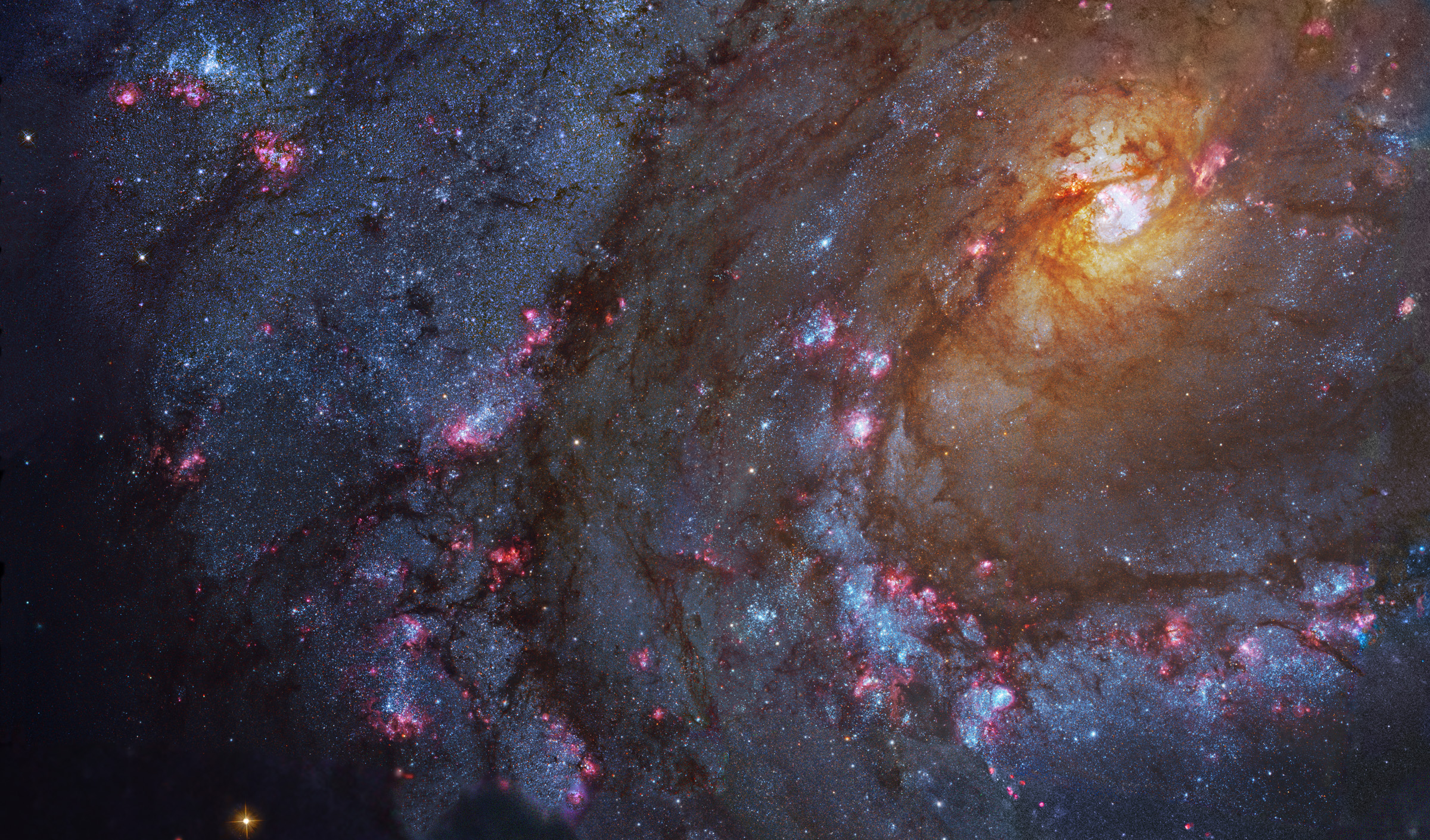
Galaxies are interesting star formations, they form both small and very large concentrations of interstellar matter, stars, and other cosmic objects, and the sizes of their disks, in the case of spiral galaxies, can reach up to hundreds of thousands of light-years. Another group of galaxies are elliptical galaxies. Elliptical galaxies are interesting formations
stars in an oval or spherical form, where the distances between the stars decrease as you approach the center of this type of galaxies and can be up to 1 light year.
Gravity holds them together, but the mechanism ensuring the stability of this type of galaxy seems to be somewhat different than in a spiral galaxy. Spiral galaxies rotate around their central bulge, so centrifugal force seems to interact with gravitational forces to establish stable positions for star systems within their structure. Additionally, something else resists the gravitational collapse of both spiral and elliptical galaxies. This remains a scientific mystery: dark matter, which barely interacts with ordinary matter and seems to maintain repulsion. This means it is matter with a negative gravitational force. Interestingly, scientific laboratories have failed to produce any amount of this type of matter, and therefore, the existence of this type of matter has not been conclusively confirmed. However, its existence is based on calculations, and its absence in space would result in the complete gravitational collapse of all matter.
Dark matter is definitelly more than standard matter, As observations of the known universe show, its expansion rate is accelerating precisely because dark matter has interactions opposite to standard matter, meaning each of its particles gravitationally repel one another. In elliptical galaxies, a balance between gravitational and centrifugal forces must be ensured. Protection against collapse does not rely on the stars' magnetic fields or the galaxies' rotation. Here, it is clearly visible that something is inhibiting the collapse of these types of galaxies, perhaps it is dark matter itself. The universe appears to be expanding in all directions, each point receding from the other. Space, not just matter, is becoming increasingly sparse. Consequently, theories have emerged that the fabric of space will be torn apart by the expansion, and with it, matter will cease to exist. All the atoms that comprise it will be torn apart and cease to exist. String theory, which discusses the multidimensionality of the universe, has also been formulated. It assumes that the universe is composed of many dimensions?more than three, as many as eleven. Individual dimensions vibrate in an 11-dimensional space. This is an attempt to explain certain unsolved problems in physics that require more than three dimensions of space to solve. This concerns tensors, which arise during computation and cannot be solved using the principles of three-dimensional space. The universe is expanding, and the rate of expansion is accelerating. This is a fact that has been observed and confirmed by scientists. However, the reason for this acceleration remains a mystery. It is believed that dark energy, a form of energy that permeates all of space and tends to accelerate the expansion of the universe, is responsible for this phenomenon. However, the nature of dark energy is still unknown, and it is one of the biggest mysteries in cosmology. The universe is full of unknown forces and phenomena that we have yet to understand, and it continues to challenge our understanding of physics and cosmology.
Earth is billions of years old, not 5,000 or 15,000 years old, since the recorded history of humans capable of writing or drawing. The buried remains and discoveries of gigantic figures with skulls large enough to hold an entire human being testify to the fact that we don't know everything about ancient times. Humans descend from earlier life forms that inhabited Earth, which underwent genetic mutations to form the current form of thinking humans. However, some of their genetic material may have originated from beyond this planet. These mutations could have been artificially induced. Who caused them and what purpose they served can only be conjectured. Will sentient life as we know it today, in the form of humans and their technology, lead to their return to the stars? Something initiated the times we live in; it could be called a form of experimenter and experiment in biological engineering, with threads of consciousness manipulation in the form of mind programming. For whom is humankind so important in terms of experimental data that life was able to persist for such a long period, until our own times? Man, possessing free will, reason, and imagination, is the master over other creatures on this planet. No other multicellular organism on planet Earth has been so endowed by fate or evolution. Does anyone observe human civilization to draw conclusions and decide to establish other cultures of this type in the universe? Was life on Earth planned? If so, for what purpose? Was man created, or evolved, to definitively shed his animal nature and become equal to the gods, or at least return to the stars to live in unity with them? Is he destined to return to cosmic freedom and gain full technological capabilities, including immortality? What if everything written in the holy books of the world's greatest religions is true, and man strives for liberation from karmic law?the law of good and evil?yet the apparent gap between man's tendency to relate his actions solely to the temporal and truth and transcendence is in fact illusory? What's blocking the shift from a civilization of death to a civilization of life and the achievement of the technology humanity still dreams of? Not all people on this planet have discovered their potential or purpose in life, and they wander practically without a higher purpose to guide them on this globe. The current technology available on Earth at key nodes isn't working. We are certainly at the beginning of our journey in mastering the arcane of technology, but history could have unfolded differently, because there were people with the potential to change the fate of billions of Earthlings, and there are such people today. However, these people were not given a voice, or their potential wasn't recognized in time. Technical civilization, in its current form, has forsaken and abandoned the concept of free energy. Work on harnessing natural forces such as gravity and inertia to serve humanity has also been omitted. While indirect applications of these solutions exist, when it comes to transportation, there has been no significant progress. Humanity has shifted more clearly toward the use of atomic energy and electromagnetism. Research into the structure of matter is already quite advanced, as is work on controlled thermonuclear fusion conducted under planetary conditions. Work on lighter energies, weak interactions, and the non-electromagnetic energies with which matter is saturated, was omitted from the research schedule. The concept of an aether, a substance enabling, among other things, the propagation of electromagnetic energy in space, and the phenomenon of inertia, or the inertia of material bodies, were rejected, likely because science still lacks understanding of their nature. Too much emphasis was placed on the electromagnetic and material basis of matter and energy, leading to a shift toward the theory of relativity without understanding the fundamentals of gravity. To date, no one, including Albert Einstein, has been able to develop a coherent theory of gravity and other fields. No one has confirmed the existence of the graviton or determined its detailed properties. No one has been able to define matter, time, and space in the broader cosmic perspective or on the smallest scale. No one has been able to determine, calculate, and pinpoint with complete certainty how matter originated, or determine how it affects space-time in terms of its own mass and the related phenomenon of gravity. It is still unknown what quark mechanism, at the intraatomic and intranuclear levels, gives rise to the phenomena of gravity and inertia. Is this the interaction of quarks themselves, or is some other undiscovered particle involved, the interaction between them, about which we still know nothing? We know that quarks are held together by gluons, which quarks exchange to maintain coherence. But when it comes to generating gravity, which almost certainly occurs within the atomic nucleus, which, after all, concentrates almost 100 percent of the mass of an electrically neutral atom thanks to the orbiting electrons (an electron has only about 1/2000 of the mass of a proton, yet atoms heavier than hydrogen contain up to 100 or more protons in their nucleus, plus neutrons), there was no way to verify this. Perhaps some work had been done, but the results were classified due to the importance of this type of discovery and its significance for science and technology, or the problem is so intellectually challenging that no one can figure it out. Personally, I think that by the time the LHC was operating, something should have been done in this direction, and the silence on this topic may indicate that something is wrong. The Higgs boson was discovered, which, as stated, is the last particle missing from the Standard Model. However, the massless particle tab only lists gluons and photons. Where is the graviton or a similar particle that exists alongside gluons in the atomic nucleus? This wasn't anticipated at all. Perhaps the generation of gravity lies in some broader physical phenomenon, or perhaps it's a field generated by the entire atom, its energetic oscillations, because electrons also possess some mass, albeit a small one, but still. More likely, however, to control gravity, one must delve into the intranuclear energy transformations of the atomic nucleus; there lies the answer. Perhaps gravity is generated by the oscillation of the atomic nucleus itself, and the mere fact that quarks exchange gluons is sufficient to generate gravity. In this case, how to influence the oscillation of the atomic nucleus to control gravity? These are precisely the same fundamental questions, to which there are currently no answers, at least not to the general public. Without a doubt, a gravitational engine that could influence gluon oscillations in an atomic nucleus to alter the gravitational properties of matter would be something sensational and unique. Perhaps this could be achieved by changing the flavor or color of a gluon, as we know that some particles, like neutrinos, can change color and transform into particles with a different rest mass when they acquire the appropriate kinetic energy. These and other questions aren't found in school textbooks, let alone answers; they're nowhere to be found. Only curiosity and a persistent search for truth can lead to concrete results. Humanity currently stands at the brink and at the beginning, and its fate depends on the knowledge it acquires. The more it learns, the further it will go, and its cognitive capabilities will be put to the ultimate test. If we want to return to the stars, we must understand these kinds of problems and apply their solutions to our own technology. We need to understand the secrets of gravity to build our own space shuttle, which will enable us to colonize other worlds, not just Mars or Earth's nearby Moon. The way we do this should be through an intelligent experimentation approach, harnessing the power of the best minds in both science and technology to accomplish this.