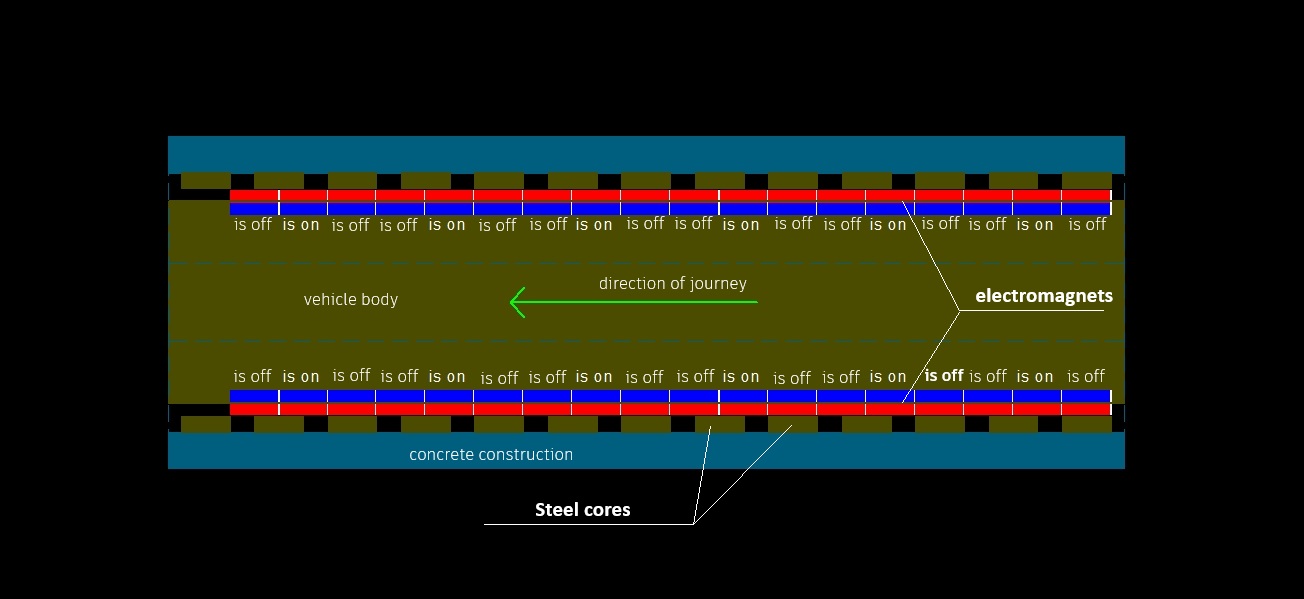
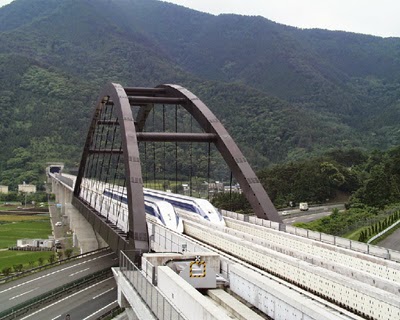
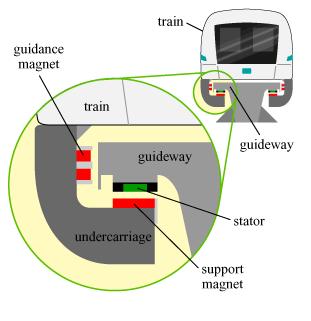
Japanese magnetic cushion train of high speed several months ago has reached already over 600 km/h speed and for now this is unbreakable limit till today for TGV or German magnetic proposition of transportation (Transrapid), but it's almost sure that even this record will be broken in nearest time maybe also by the same high speed Japanese vehicle. The cost of magnetic train propulsion now is beyond of economic possibilities of most governments programs of rail transportation in today's world. Only several countries has realized small magnetic transportation enterprises and this is China, Japan and Germany. The most important problem with application of Maglev is the need of construction entire new infrastructure, old infrastructure is in this case useless, so this is connected with much more complication than operate on old railway net with gradual innovation in this ground with old technologies but relatively less expensive. However perhaps there're some more intelligent solutions on this magnetic kind of transport much chipper and simultaneously better in every details. Magnetic linear motor is simply nothing else like only linear presentation of a common electric motor. In better solution of linear motor this is the frequency magnetic pulses needed for propulsion only with half energy requirements. So, as it can be seen in further part of this post, in standard maglev propulsion there's energy spoiling in all the system. If we will use proper guideway construction compound of some ferromagnetic materials and blank spaces one by one we can do the same as standard linear motor can do and with half energy consumption requirements. In this case there will be some frequency magnetic field with long horizontal located electromagnets mounted on the train and it'll be switch on as the train is going ahead always in the same geometric coordinates near each soft steel elements till the end of partial electromagnets beams. No need to change polarity of electromagnets in aim of change the movement direction of the train. Only nearness of actual electromagnet to a soft steel elements is important to determine of the journey direction and thrust.
Switching on of electromagnets
9 September 2020
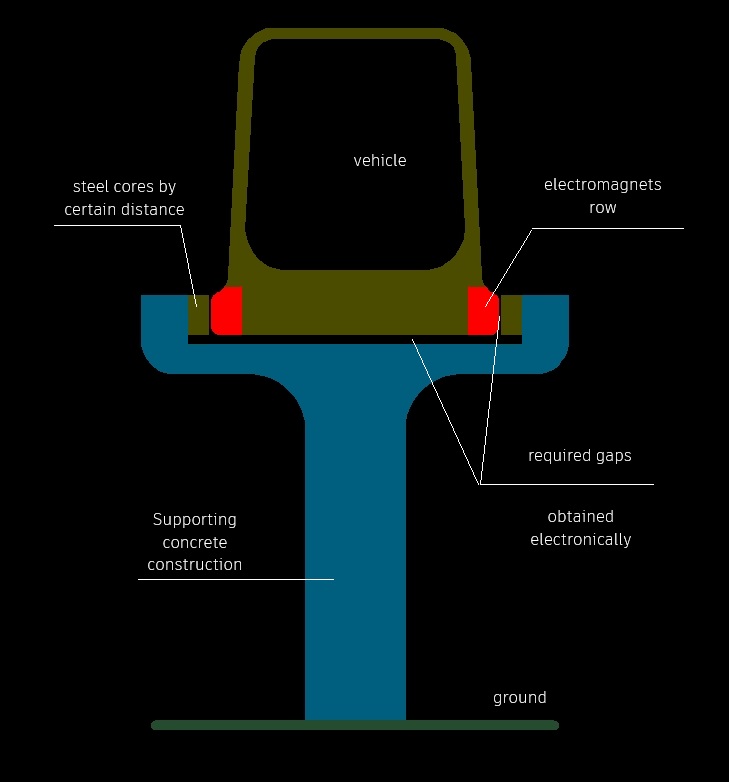
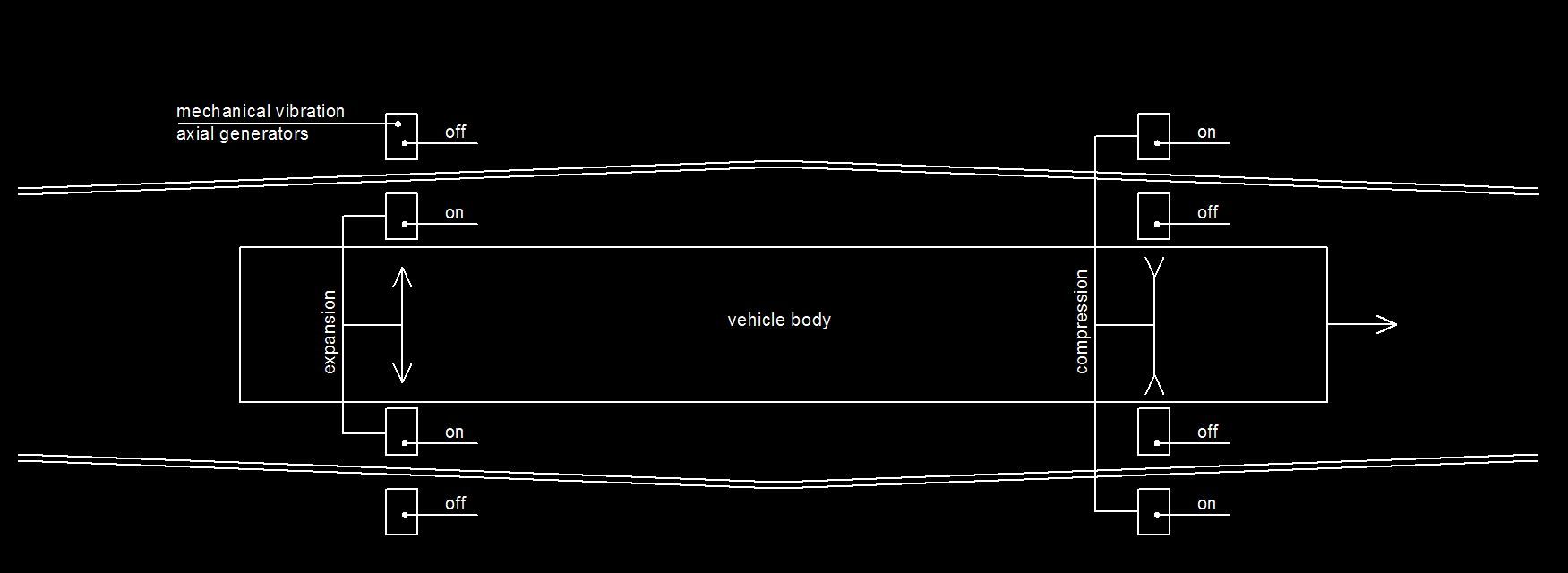
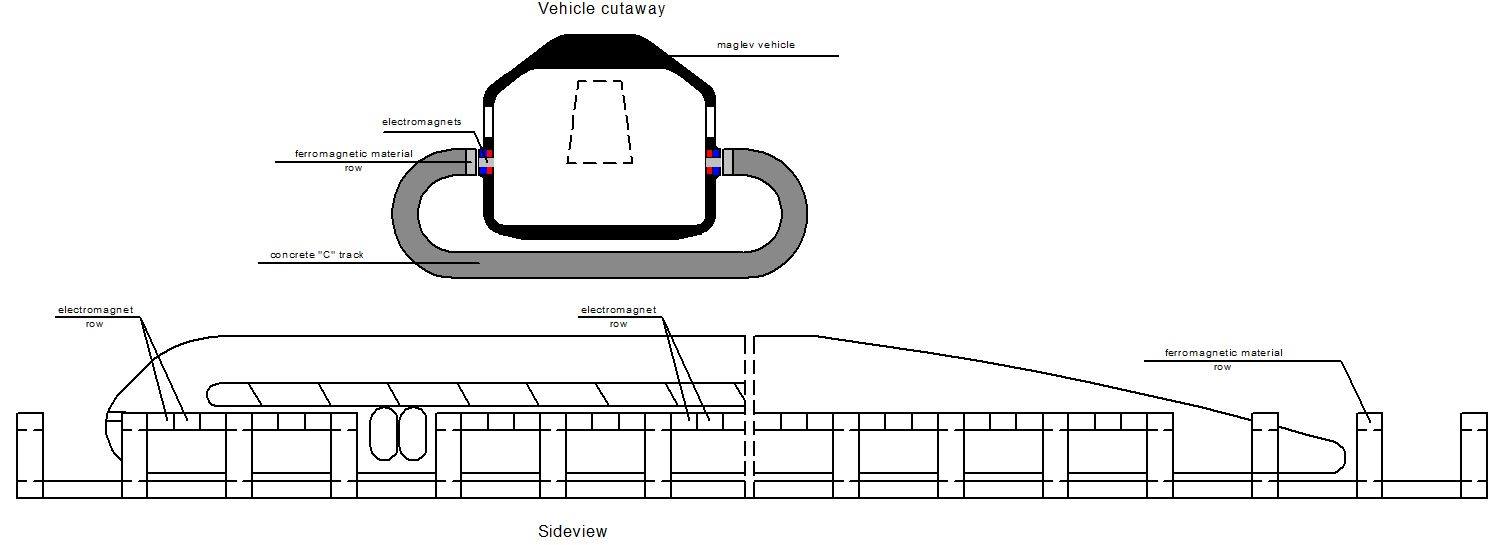
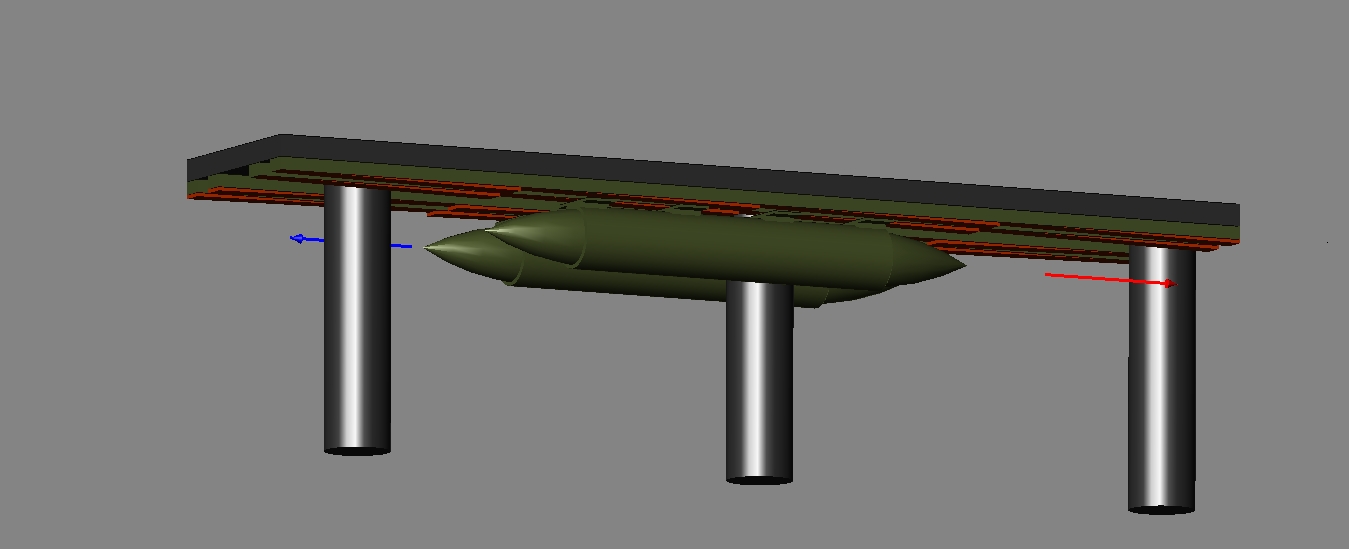
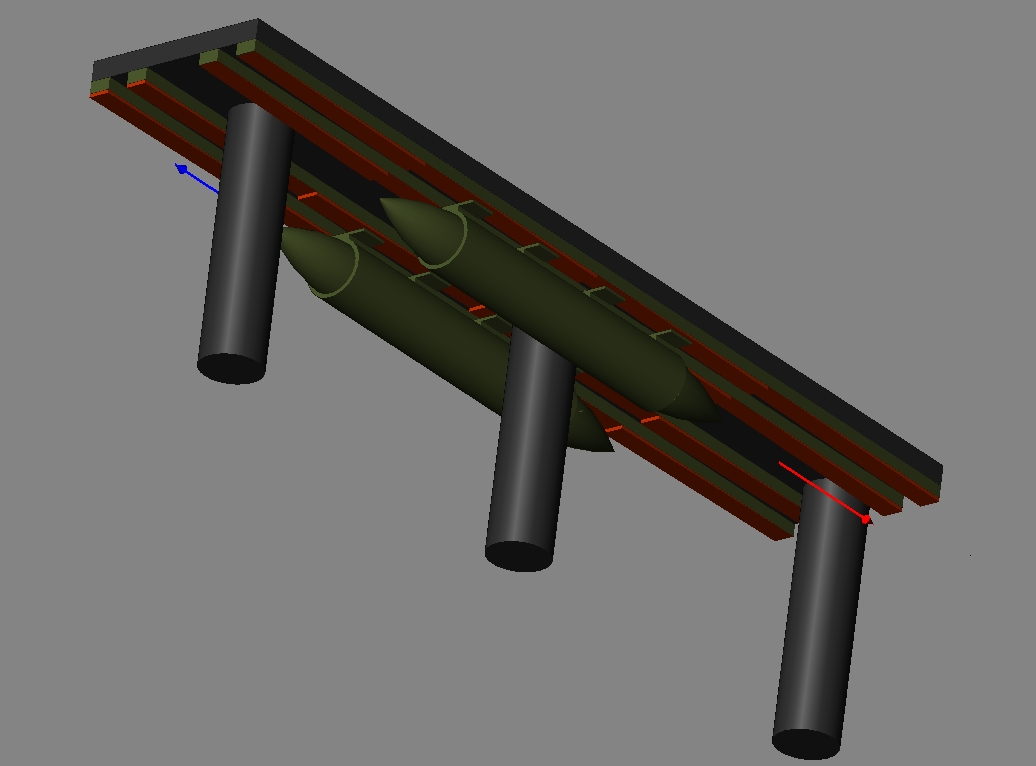
Magnetic linear motor. The real Maglev train in action. But here is a slightly different solution also with magnetic principle but rather based on alternated magnetic side beams frequency propulsion attraction to steel cores located on specific concrete and steel guidway new idea. Side beams are located on bottom position on left and right side of the vehicle ( on this picture named as the electromagnets beams ). Each time an electromagnet is on and the the steel core is near, magnetic force is pushing the vehicle inside the guidway and ahead. When electromagnet is on the right position equal to position of the steel core than is switching off and the next electromagnet is on. This situation is the same with each electromagnets in entire side bottom power beam so the vehicle can be accelerated to a great velocity only with half a power as in standard electromagnets linear motors. There is also no need to create separate magnetic lift system (magnetic cushion) because the vehicle is automatically lifted on the right position in this new solution. The only need is the proper electronic position detecting control just like in standard approaching control system in standard Maglev propulsion in use in Tyssen-Krupp solution. If this system has a weak sides than it should be considered as the solution which was created without proper economic support and the solution need some financial care and if it'll be so than the effect will be also adequate.
Vehicle inside the guideway
Side view
Japanese Maglev
9 September 2020
Transrapid a train on a magnetic cushion and Levitron. Examples of using magnetic forces to achieve magnetic levitation. Understanding the principles of magnetic interaction allows for the mastery of a number of technologies that could lead to the future development of advanced techniques capable of propelling spacecraft. Currently, purely magnetic propulsion based solely on the principles of a magnetic field is still the stuff of science fiction. Technologies utilizing plasma accelerated in a magnetic field are being considered on a fairly large scale, but this is still rocket propulsion. Space magnetic propulsion based solely on the interaction of two electromagnets would require technologies that are not yet available, primarily due to the need to generate very short magnetic pulses. Because a magnetic field propagates in a vacuum at the speed of light, to achieve magnetic pulse separation, one would first need to find a way to generate sub-picosecond magnetic pulses to achieve magnetic thrust. Detailed information on this type of propulsion was once available on several websites, but little is currently discussed. A few years ago, it seemed interesting, but other concepts are currently being developed more widely. A completely different concept is propulsion using magnetospheres?those of the Earth, the Sun, other stars, or an entire galaxy. In practice, most planets, stars, and galaxies possess their own magnetic fields, but these fields, like our galaxy's, are very weak, even weaker than Earth's magnetosphere and millions of times weaker than the Sun's magnetosphere at a given distance. However, if it were possible to generate very large magnetic fields that could create magnetic forces (attractive or repulsive) in relation to the galaxy's external magnetic field, one could theoretically travel along these forces like a kind of magnetic sailboat. Another method could involve generating strong, looped magnetic fields that would literally launch spacecraft using their own stored energy within the magnetic field, yielding lower energy, the loss of which could be used to accelerate the spacecraft to near-light speeds. This would require the use of certain nuances of electric charges, which would be associated with the spacecraft itself. Magnetic energy would be utilized through rapid depolarization in such a vehicle's engines. However, these are only ideas, so it would be necessary to analyze how magnetic energy would be stored and segmented to release kinetic energy. It seems that such propulsion would take into account phenomena such as magnetic shape memory and other phenomena related to the electromagnetic field, particularly in connection with the structure of electrically polarized molecules and substances based on them.
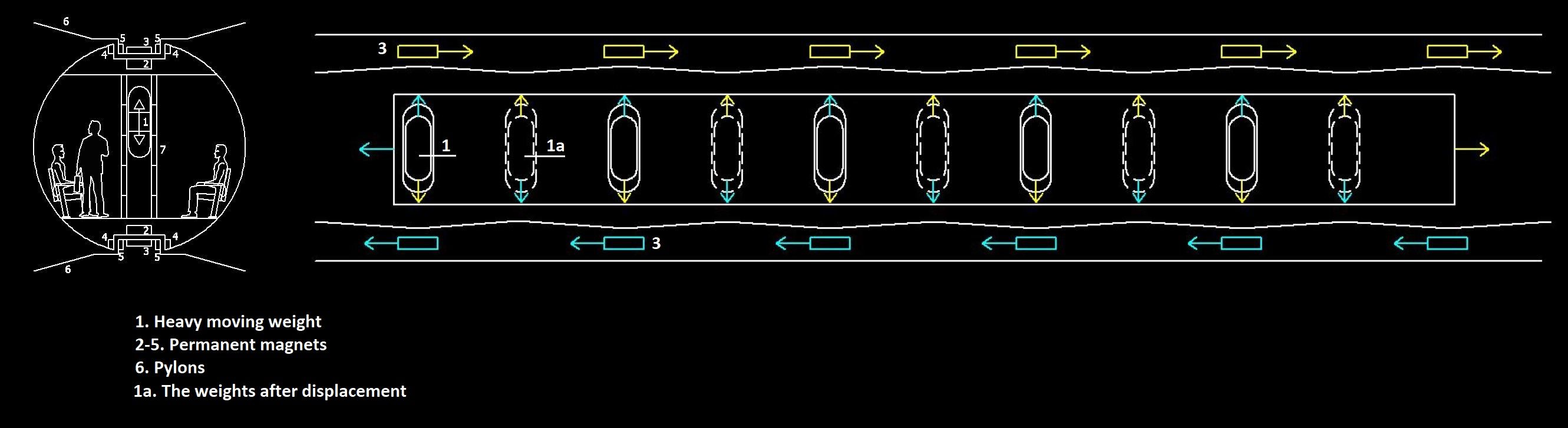
I'd like to present a completely new solution in land transport, such as rail transport. It's a combination of magnetic field technology and the use of inertial forces. This is an example of using a moving weight and its inertial properties in the Earth's gravitational field. The entire concept involves synchronizing an oscillating load with the magnetic rails on which the train moves. Now, an explanation of how it works. As the loads move upward, they exceed the forces resulting from the entire weight of the train, pressing it against an upper beam, which is slightly inclined upward at the opposite end, towards which the vehicle begins to move. This occurs because, in this case, the force of gravity and the weight of the entire train have been temporarily overcome, and the resultant weight presses against the upper beam. When the train moves slightly upward, it simultaneously begins to accelerate due to its support on the incline. This is because the inertial forces are now greater than when the train is in the inertial phase of Earth's gravity. After passing the upper beam section, the situation repeats, with the difference that the load now acts with a force in the direction of Earth's gravity, pressing the train against the lower beam. As a result, the train begins to descend the lower slope, moving in the same direction as before and accelerating at an increasingly faster rate. The cycles then repeat. The essence of this solution lies in synchronizing the mass movement phases with the train's current position. The entire system can operate with minimal inclination values, high vibration frequencies, and very short beam sections. This concept has several drawbacks, the main being the train's limited ability to overcome slopes and the need for costly infrastructure. This type of drive is based on magnetic levitation using permanent magnets, or permanent magnets and electromagnets. However, these do not generate driving force as in conventional maglev railways, but merely eliminate friction.
Movable load.
New inertial propulsion.
9 September 2020
Inertial propulsion system for railway technology is probably completely new thing. As it result from my latest observations of reality in Poland and eastern Europe there're relatively low or even almost none interest about inertial propulsion and the situation seems to not going to any better state. The old conceptions are blocking new solutions in this case as usually. In most of countries on the old continent there're still developed methods based on internal combustion engines or on electric motors as a railway propulsion systems. Bearings and too many other mechanical parts here are the main problem - they have application in almost every kind of engine produced today, and as it is widely confirmed in technology, the simpler is a mechanical device, the less complication there is with it in further exploitation. Thus this is why inertial propulsion in some cases is sometimes better solution, although it's still based mostly on an mechanical idea. Inertial propulsion could have applications in space transport but also in railway transport systems, there are a lot of opportunities in technology for this type of solutions.
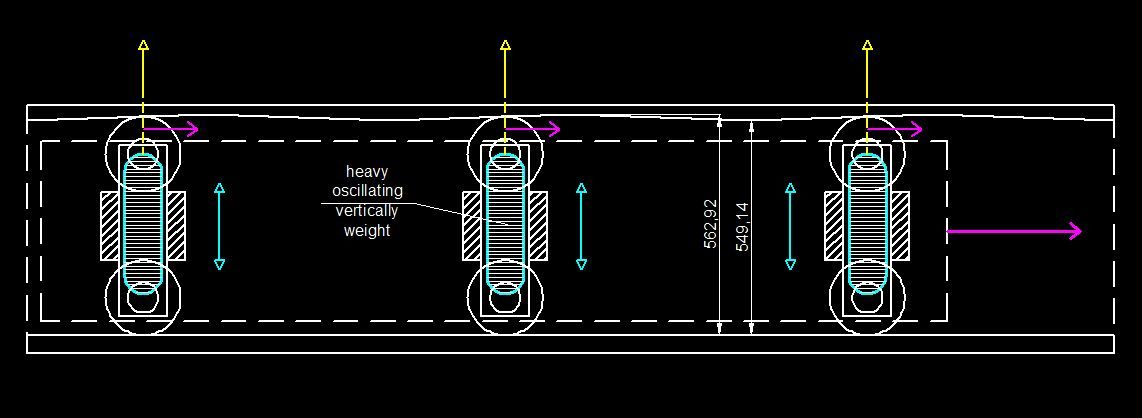
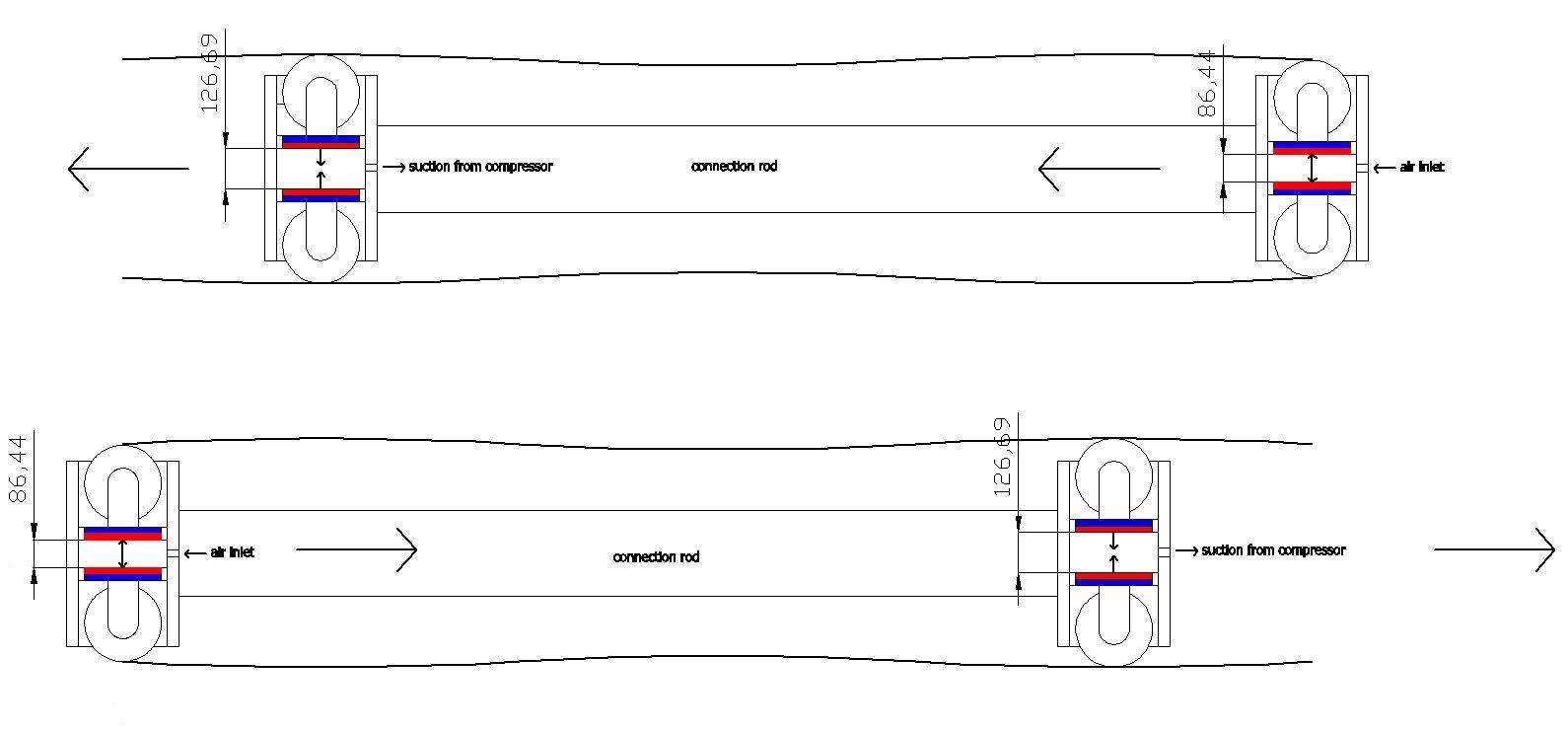
The method on the picture 3 above will be working properly only before solving the problem of electromagnets (magnets) mounted below to the vehicle, because the T - beam on which they are moving along, works to the vehicle like magnetic brake as it is going ahead on this beam. This problem is the result of ferromagnetic interaction between the beam and moving vehicle with those electromagnets, this problem persist if we want to apply T - beam made of steel . The electromagnets are used in the aim to push or pull the vehicle to propulsion upper beams (to support beams) as is shown on the cutaway picture 3. There must be some space between up and low surface and each side of low T - beam, because according to proper operation of this propulsion vehicle is lifted up or dragged down (Picture 2) continuously during acceleration of this vehicle. Using magnetic field with the T-beam in this case has an rational explanation and seems not to become simpler by using vacuum or air pressure. Some kind of friction elimination must be used to support beams. Each time the vehicle is on the gravity complying support beam side the gravity acting on the people inside is decreased, and if the vehicle is on against gravity beam side of the beam which is slightly leading upward, the people inside will be feeling more gravity force which will adds to normal gravity. The electromagnets has both opportunity to work only with complying surface of the suport beam, than the vehicle will have 50 % efficiency but there won't be necessary to switch on the lower electromagnets or with the two direction state in which upper and lower electromagnets are on during vehicle movement. All this inertial solutions require some general conditions. First disadvantage and simultaneously condition is the need of horizontal position ( there could be some level differences on long scale of whole track but we cannot use it with too higher vertical differences on short distances, this mean that the total difference between certain fragment of the track in vertical difference cannot be greater than the difference on local beam situation) of the beams what eliminate some of important application eventualities which can be achieved simply by using standard railway systems. However knowing about that main disadvantage still this propulsion seems to be interesting. Another solution is an application of doubled surface suport beam. In this case one surface is placed upon another, thus the whole thing is now much simpler as is shown on Picture 4.
The propulsion systems until this day are related to internal combustion engines or electric motors application, very rare is magnetic levitation propulsion system. Here is some information about inertial propulsion for railway application. Latest technology existing in the world according to propulsion system is based on artificial generated forces mainly related to pressure differences or to jet reaction, a huge part of nowadays technology is based on electric motors and especially on internal combustion engines. Using inertial or gravity forces to propulsion of anything still seems to be a distant future. However some considerations can be achieve to better understanding of such a topics on technology field. Now I allow myself to present some technology which is based on inertial and gravity natural forces application which is visible as below picture.
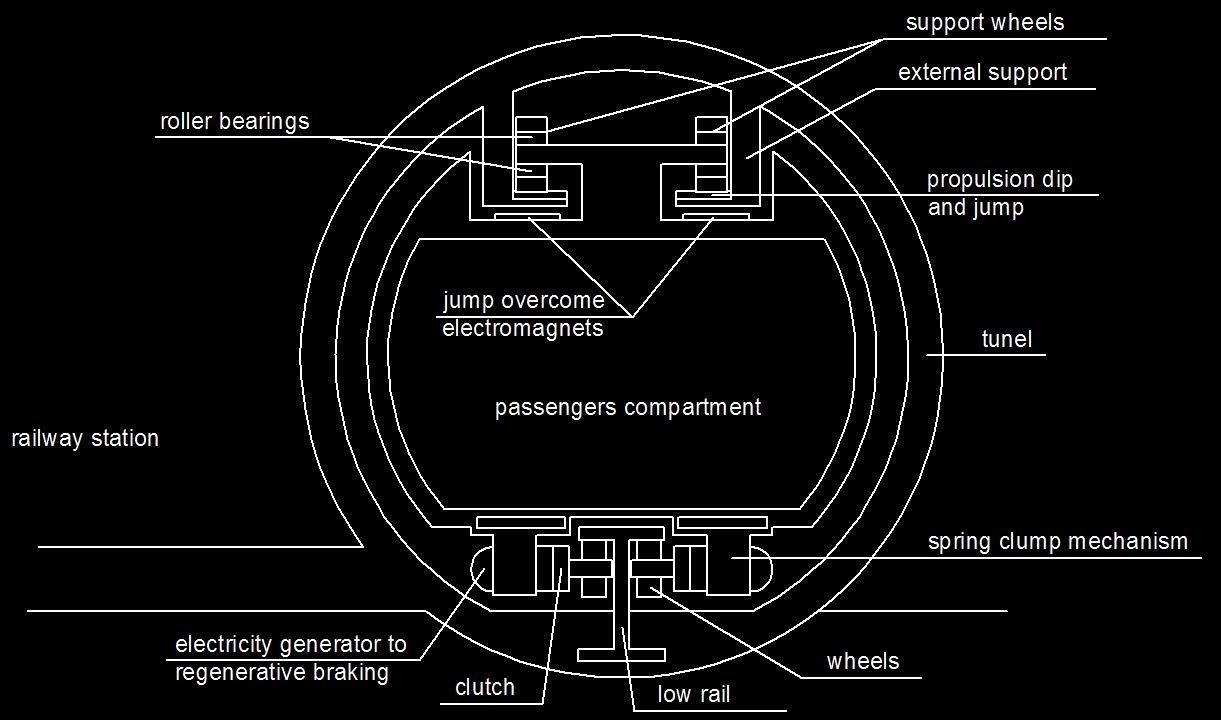
This is a case of cutaway of the tunel situation in which the train is moving. The entire construction for the train is made from reinforced concrete and steel. The vehicle is supported on construction which is made of steel and it is moving on wheels with roller bearings or on air pressure cushions. The track has a propulsion dips placed continuously on its entire length which is optimized to local external environmental requirements. It is recommended in this case to place the guide-ways in near to horizontal plane as much as is possible to avoid level differences on its way. Main principle of this idea is very simple and it is based on gravity force which is dragging down the train what is caused by each individual dip located on the upper guide-way from the upside. The guide-way must poses the jump. The jump is required because there is no other way to overcome individual level differences without its presence. In this aim there are used jump overcoming electromagnets. The electromagnets are turning on each time the wheel is in nearness of the jump location lifting the entire vehicle slightly and helping the wheel to overcome level differences. In reality the jump should be optimized to proper dimensions depending from the local environmental requirements. The system has projected electricity generators to regenerative braking on the deck. At the bottom is placed steel beam. The role of this beam is to make stronger the pressure on the external support by the wheels thus the vehicle can accelerate faster and it is achieved by spring clump mechanism. Now it is clear that the vehicle need very low electricity energy to its operating.
The electromagnets used to cross the jumps will be probably slightly decelerating the train and may be also used as a brakes to slow down the vehicle when is the need, there are several ways to omit this problem: first is to project an individual clump system with wheels especially for crossing the jumps or the second way is to completely eliminate the jumps using doubled dips each in the opposite direction but this will to require the use of different propulsion method and different electronic control and than the entire propulsion system should be projected once again with the proper data.
The question is why to create such a weird propulsion systems at all when there are already good standard propulsion methods in current world transportation solutions ? For me is mainly important to check some gravity effects related to this technology, this is why I try to consider this kind of solutions. I hope that someday my idea come true and this technology will enter to realization phase, but currently this is only my individual wish.
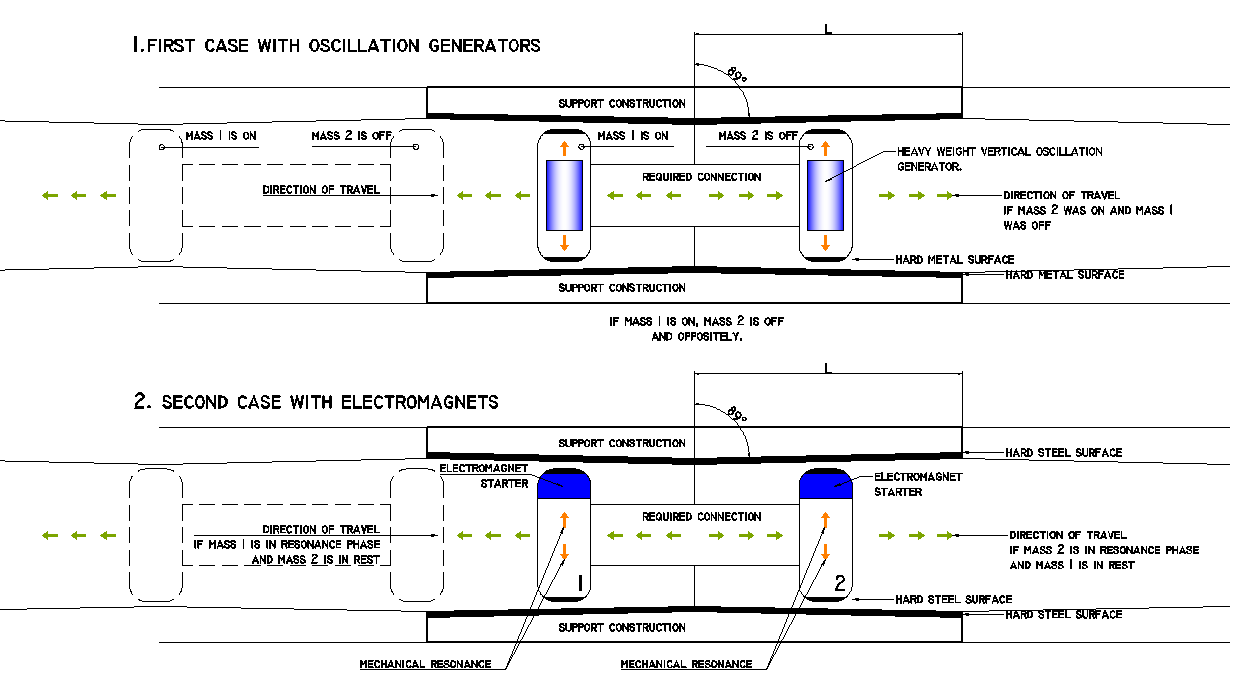
The scheme of transport method based on internal collision effects on inclined by one-degree surfaces made from hard, smooth metallic material. The support external construction should be made from stiff reinforced concrete. If movement would be directed to the left, the oscillation of mass one should be turned off once the mass is entering on oppositely inclined surfaces. At the same time, the mass two should be turned on to the oscillation, so the movement would be smooth, and the vehicle could accelerate to the left. Mass is produce thrust only on getting wider in vertical plane surface complying to the direction of travel, and the oppositely connected mass is responsible for oppositely directed movement or for deceleration aims. The oscillation effect should be obtained magnetically or mechanically. The system can consist of many such a mass connected with each other stiffly. There are many ways to avoid increasing friction between masses and the track surfaces. However, if the system would be working fast the real friction would be minimal because the contact with surfaces would be decreased. Masses should be retracted by collision to center position between each of inclined surfaces and each time them do so, they will be moving ahead a little in the demanded direction complying with the gap which will be wider on the other end. The entire difference should be not too big in start position and in end position, because the wider place between the surfaces, the more time the mass will need to overcome the space between them so the velocity will be decreasing fast, especially without an energy addition from the planned source of power. In the second case there is an opportunity and it is highly recommended to keep both masses in the resonance phase at the same time, so the two-directional movement would be obtained after disturbing a balance between both masses placed on both side of inclinations. If the vibrations coming from the resonance would be greater on one side the balance would be displaced on this side so the train would be moving ahead in complying direction.
10 September 2020
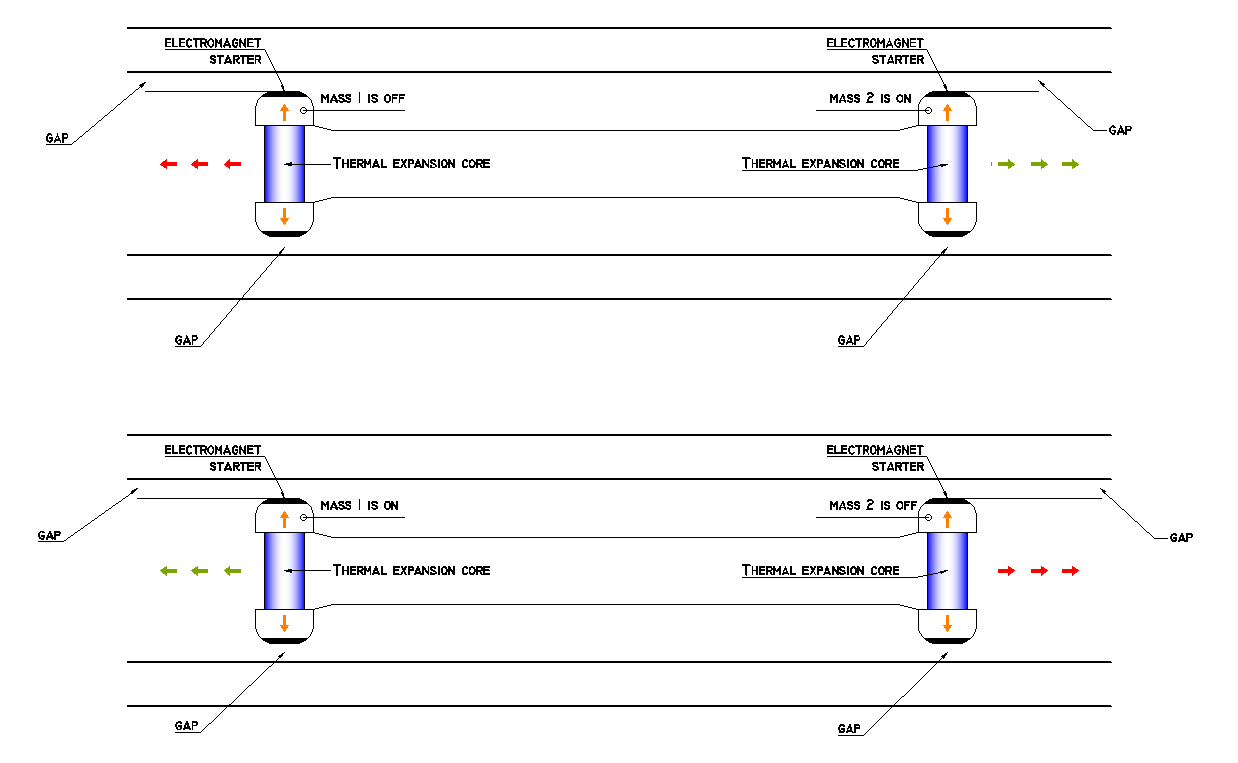
Inertial force coming from centrifugal force is the base solution according to the below scheme. The main advantage in this case is lack of obligation to application any inclination of above and below surfaces. The propulsion is based on application of mechanical resonance obtained by use of electromagnetic starter. The resonance is sustained by regulation with thermal expansion of expansion cores and for this aim there are heaters which will be delivering require quantity of thermal energy with electronic control. The gap needed to operation of the propulsion is narrow, and the second gap is only for available the vehicle for moving and is equal almost zero. The starter will be used only when it is need for begin travel. The track surface should be made from hard and stiff materials for obtaining smooth and hard moving surfaces. This train propulsion is working due to mechanical resonance and the internal cores are bouncing between steel rails, so the centrifugal force is rising without almost zero additional powering needed. The only required energy for controlling the chassis systems is coming from the heat and thermal expansion coming from that heat affecting on internal cores placed between the friction layers. This system has practically zero requirements about external energy delivering. Additionally energy created during the system displacement coming from the friction and produced hit during this process can be used for creating electric energy on the deck for internal requirements of the trains, also for heating the expansion cores as well. Every revolutionary invention has several stages before it become technology widely applicated, in first stages it is ridiculed, next opposed and at the end it is accepted as self-evident.
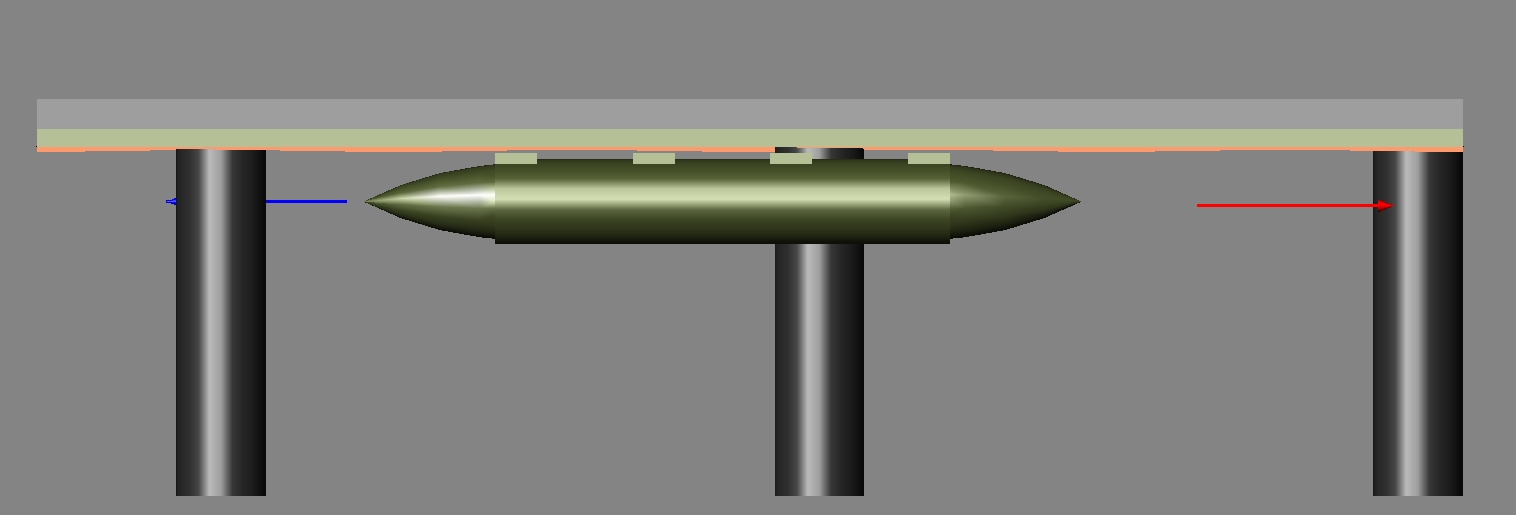
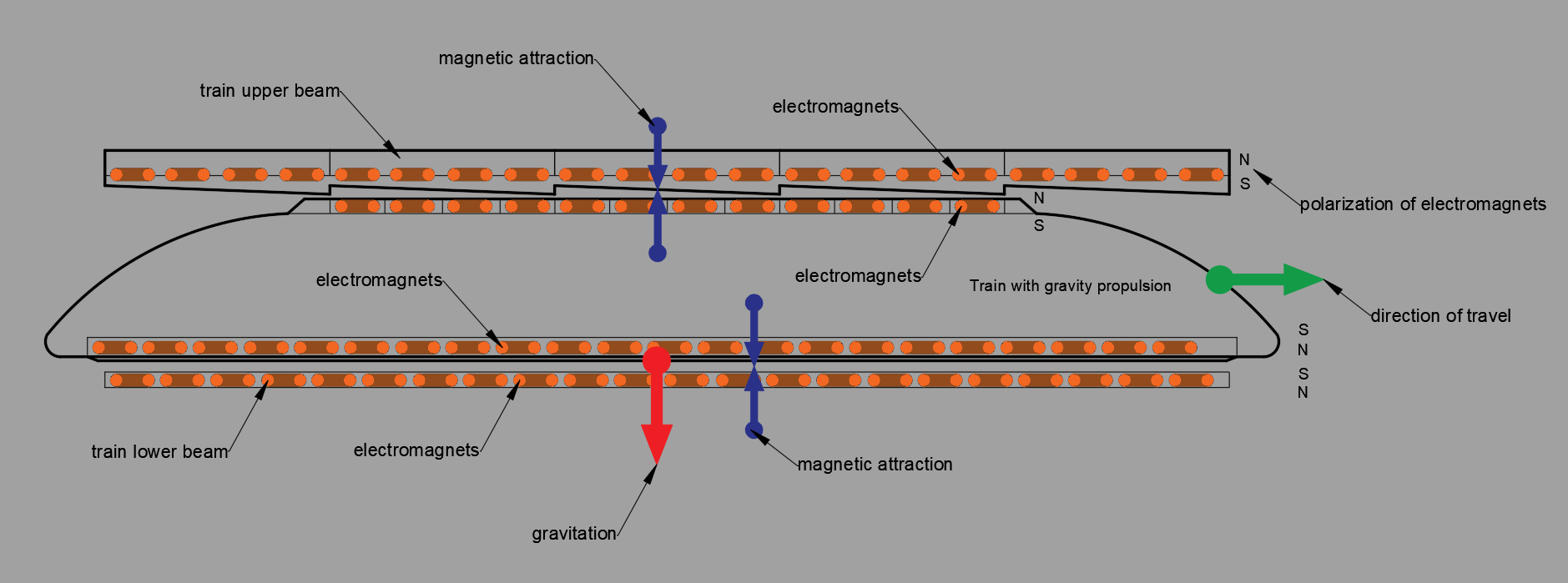
I want to present a gravity propulsion for rail systems. This propulsion is based on quite simple assumptions. The system consists of upper track with electromagnets beam, lower electromagnets beam and upper and lower electromagnet row in train. The track is specifically shaped and is formed by ramps on certain inclination and all is made from steel, electromagnets are wired with copper wire. The train could move in both direction and it is possible after reversing the electromagnets polarization on repulsion. Not every electromagnet should be turned on in the one moment. The electromagnets in upper beam and lower beam should be switched on only when the train is arriving on its position. The electromagnets in vehicle should be switched on not simultaneously too. Between lower beam and bottom electromagnet row in the vehicle is attraction also between upper beam and top electromagnet row in the vehicle is the same. The vehicle can speed up due to attraction between lower beam and lower electromagnet row in the train - gravity vector is multiplicated by this magnetic force. Magnetic interaction between upper beam and top magnetic electromagnet row in the vehicle has to its aim to create an ability for train to continuous falling on the ramps simultaneously pulling the entire vehicle forward. The train is to move along and between the upper beam and lower beam without touching the surfaces. It is a magnetic trapping of the entire vehicle on the right position in the middle of the space between them.The vehicle can work in gravity field, there is an opportunity of travel for people and loads. The system could make available of travel on flat planetary surfaces or underneath the planetary surfaces in tunnels. This is also a kind of attempt to create the system which can control the gravity vector on the deck while the vehicle is moving ahead. The electromagnets should be swiched on in the right position, what means that the system need to be controlled by a specific software and hardware. One should thing over what inclination of the ramps is the best. More inclination means more force potential but should be not too high due to general requirements. The entire system strongly is magnetized, to generate this is required much energy, so the system is not self-sustaining with energy. The steel is all the time magnetized during the vehicle passing but it is not working on changing magnetic field in polarization what is only happen if the vehicle is to change the travel direction. Once the train is to travel in right direction the gravity force on the deck will be decreased, on the other direction the gravity force will be increased, and those additional values will be added to local gravity vector. This system can have its application in terrain travel such a like new generation rail or underground.