9 September 2020
Traveling at speeds faster than the speed of light is currently unattainable for our technology. The theory of relativity assumes that conventional matter can never travel faster than the speed of light. Adding velocities in this case has no effect on the final velocity, as the Lorentz law and transformation apply. A material body for which the speed of light is an upper limit, which it will never exceed. This limit results from its own mass, its inertia, and the properties of the universe we live in. Miguel Alcubierre is one of the few scientists in modern physics to have put forward his own concept of FTL (faster-than-light) travel.

His concept does not challenge the principles of Albert Einstein's theory of relativity, but merely lays the foundations for a possible technological loophole in which the commonly known principles of relativity can be bypassed. Alcubierre's concept involves generating a spatial bubble in which a spacecraft would be immersed. According to the above concept, space, which has no mass, can move at speeds greater than the speed of light because it is not limited by mass?the theory of relativity only addresses mass and its inertia. A spatial bubble could move faster than light, along with the vehicle inside it, if certain conditions were met, primarily relating to the ability to generate gravitational fields, including fields with negative gravitational polarity. It must be stated here that mastering the phenomena of gravity and inertia is, consequently, a path that opens the door to deep space exploration.

Without mastering these fundamental energies and fields, interstellar travel, including direct exploration of extrasolar planets, is impossible. Other technologies often serve as secondary goals in this context, bypassing the core of any meaningful means of communication and transportation across the vast expanse of the universe. Interestingly, there are other technologies, little discussed today, that have already been developed by scientists and inventors sometimes considered rather eccentric cultivators of such unusual science and technology. These technologies include telekinetic propulsion and teleportation propulsion. It should also be added that there are also some works based on which attempts have been made to create propulsion systems such as antigravity propulsion and various types of propulsion that do not generate antigravity but modify the properties of fields, as well as the properties of space itself. The field energy resulting from the interaction of space with matter, or matter activated by specific technological processes to achieve modified fields, and space itself are significantly interconnected. Telekinetic propulsion falls more within the realm of parasciences, such as parapsychology, dowsing, or bioenergy therapy, represented by psychokinesis, etc. However, from the perspective of science and the well-being of civilization, no technology is so strange or absurd that it cannot be explored, especially when the benefits of research results can lead to various, sometimes even fantastic, possibilities. In the case of telekinesis, these could include mastering methods of penetrating material barriers, teleportation, or generating arbitrary amounts of energy for industrial purposes. Of course, from both a practical and theoretical perspective, there are other technologically feasible methods that have been considered previously, or those that are so far beyond the horizon of modern science that they haven't even been conceived of yet. For example, when it comes to antigravity technology, which could practically enable breaking the "speed of light barrier," like other technologies with comparable capabilities, their fundamentals have not yet been mastered on a large scale (not necessarily on a laboratory or prototype scale). A widespread global blockage of the development of these technologies has occurred. The work of some scientists and research centers has been abandoned or taken over by the military. Considering technologically enhanced telekinetic propulsion, most data on this topic is speculative. However, there are scientific materials and papers, sometimes of a high degree of technological advancement, but access to them appears to be strictly controlled or tainted with disinformation combined with cybernetic interference. There are few scientists in the world today who would even be willing to discuss telekinetic propulsion and related techniques, as their scientific "backyard" is predetermined by the funding of their own projects by their management. Even when they encounter compelling arguments in this field, they ignore them. You can also encounter individuals who attempt to popularize propulsion and the production of electrical or thermal energy through the use of phenomena based on the telekinetic effect, but they are generally ignored. However, in reality, to deny them greater opportunities, it is enough that the obstacles placed in their way prove so significant that their room for maneuver in society is minimized.
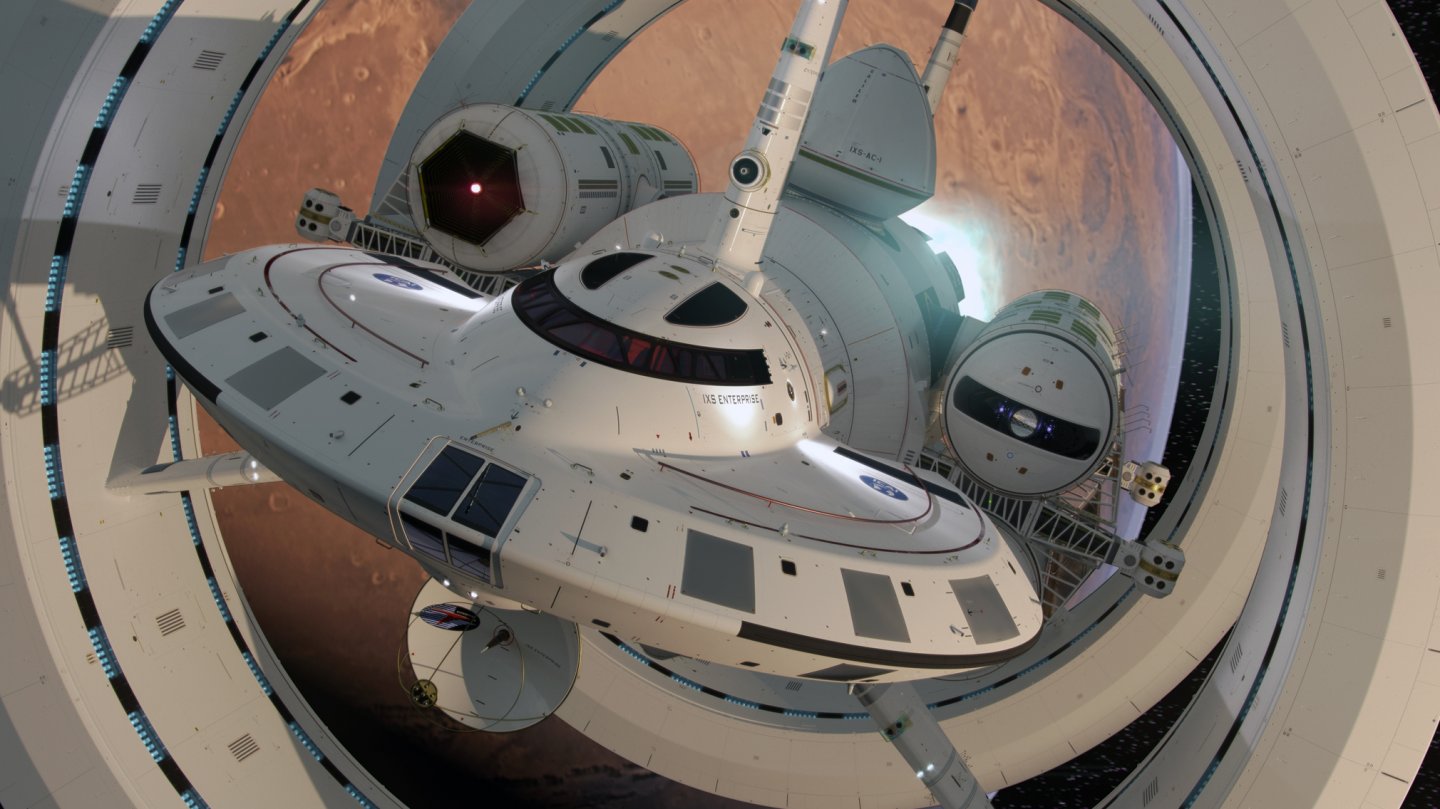
Another form of propulsion, if it can even be called propulsion, is technologically assisted teleportation. This form of space travel is more familiar, having been popularized by a number of films, such as the Star Trek series and many others. Many other studies offer alleged examples of how FTL propulsion could be developed, but so far, no one has become the next Zefram Cochrane from First Contact in the Star Trek saga; these are all merely delusions of real technology. Does faith in such a great man as Albert Einstein cause such enormous problems that nothing can be done about it? To quote Einstein, who once said an anecdote: "Everyone knows that something can't be done, and then someone comes along who doesn't know it and does it..." These words may indicate that Einstein didn't fully believe in what he postulated, and in particular, he allowed for the possibility that his theories and the limits he defined might one day be broken. Everything Einstein postulated stemmed from mathematical analysis and thought experiments. Einstein never performed experiments in nature, after all, he was a theoretician. However, this fact may indicate that there are different realities at the quantum and real levels that cannot be calculated. indeterminate constants, which only arise under specific experimental conditions, and not on paper.