Magnetic field is associated with the spatial orientation of magnetic dipoles, which involve the constant magnetization of a material medium or depend on the flow of plasma or electric current. In a normally unmagnetized medium, the axes of magnetic dipoles are arranged in a chaotic and disordered manner. By supplying energy from an external field through a coil carrying an electric current or a permanent magnet that already has magnetization (e.g., a neodymium magnet), we cause the magnetic dipoles to align with the direction of the forces of this external magnetic field. Our knowledge of the magnetic field is incomparably greater than that of the gravitational field. We can generate strong magnetic fields using superconducting magnets or produce permanent magnets with considerable field energy through metallurgy and powder magnetization, as in the case of neodymium magnets. As for the gravitational field, we cannot control it satisfactorily. The mechanism of operation in the case of gravity remains shrouded in mystery, although progress is constantly being made in the study of the gravitational field, this barrier has not been definitively overcome. It should be noted that internal forces somehow hide their secrets from scientists, because despite knowing the principles of interaction of elementary particles such as quarks, gluons, and electrons, and being aware of numerous nuclear transformations, we still cannot grasp the essence of gravitational interaction both on the micro scale at the level of elementary particles and globally. The magnetic field currently presents a whole range of phenomena involving it, which are also not fully described or observed. Similarly, the gravitational field has a broader range of influence and is more penetrating than the magnetic field, which we can currently shield (e.g., the Meissner effect - the disappearance - expulsion of the magnetic field in a superconductor). Certain paths seem to lead to many common relationships between the magnetic field (magnetization) and the phenomenon of gravitational wave generation. Although the magnetic field is typically dependent on higher organized material processes, the gravitational field is fundamentally related to the rest mass of elementary particles. It is probably therefore reasonable to assume a close correlation between mass and magnetic field. The magnetic field can impart kinetic energy to a charged particle within its range, hence the simple conclusion that, according to the equivalence of mass and energy, it contributes to the increase in the mass of this particle. This is the case, for example, in particle accelerators (e.g., LHC) where particles, in this case hadrons - protons, can be accelerated to energies even on the order of TeV (teraelectronvolts), which corresponds to achieving relativistic speeds for these hadrons. From the perspective of energy and its possibilities, it is crucial how to "access" the practically infinite renewable amount of energy contained in the field of permanent magnets or in the gravitational field of planets. Over the centuries, various inventors (such as Bessler with his wheel, or other seekers of "perpetuum mobile") have tried their hand at harnessing gravity or obtaining electrical energy from the energy of magnetic fields. As can be seen, so far no one has succeeded in doing so, and the world is moving in a completely different direction, it is difficult to predict whether it is good or bad. However, undoubtedly, the energy of gravitational and magnetic fields is tangible and inherent energy, resulting from the very basic properties of matter, and certainly also from the properties of space, which they somehow alter to reveal these fundamental simple principles. Gravitational energy is energy acting over a greater distance, the energy of the field seems to be limited by the very properties of space, which does not diminish the fact that the electromagnetic wave does not have such limitations, and it is difficult to determine the cause of this discrepancy, the permeability of the vacuum to magnetic and electromagnetic fields is probably significant. However, as long as the theoretical foundations prevent understanding of this field, there will be no possibility of creating more advanced technologies, and we will be moving in this area blindly. It is already quite clear and should be acknowledged that as long as this barrier is not broken, humans will not leave the solar system.
Gravitational propulsion
10 October 2024
Developing technology capable of meeting the requirements for safe and rapid travel between planetary systems adjacent to our solar system is, given the current nature of science, which is characterized by a skeptical approach to certain matters of technology and advanced knowledge, problematic to say the least. The only thing that could change this type of dependency based on contemporary knowledge are materials solutions, which are currently undergoing rapid, positive changes. From my perspective, I can say that this will open up enormous possibilities, leading to the development of lightweight and durable materials and high-temperature superconductors, enabling the development of magnetic field-based vehicles?the Hall or Lorentz effect?that could lead to the rapid colonization of rocky planets in our solar system at an unprecedented pace.
Magnetic propulsion recently is concerned as a magnetic sail propulsion or plasma propulsion as a VASIMR drive. On the field of recent science and technology it is faintly underlined the opportunity of use a purely magnetic non-rocket propulsion and still there are no crucial solutions in this field. Lately I had proposed several eventually interesting solutions which might be omitted by a larger fraction of international community. So I decided to post one more idea to make the problem of the need of magnetic propulsion to be solve more visible. As I am presenting a content connected only with my hobby in a small laboratory environment I don't think that such a technological solutions will see the daylight quickly due to the great advantage of industry based on wasting energy and human resources, upon my works. I am not fanatic to the propulsions I've invented I only see some possibilities, that I want to show to don't let to progressing elimination of independent thinking in recent existing people masses.
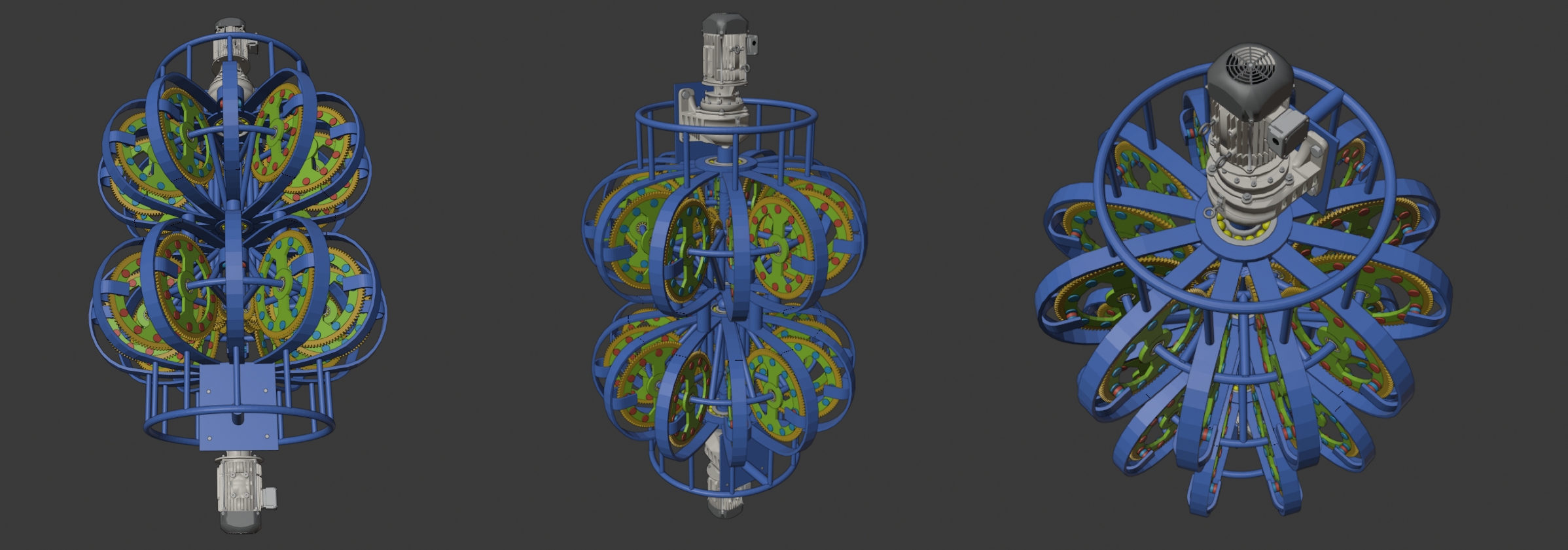
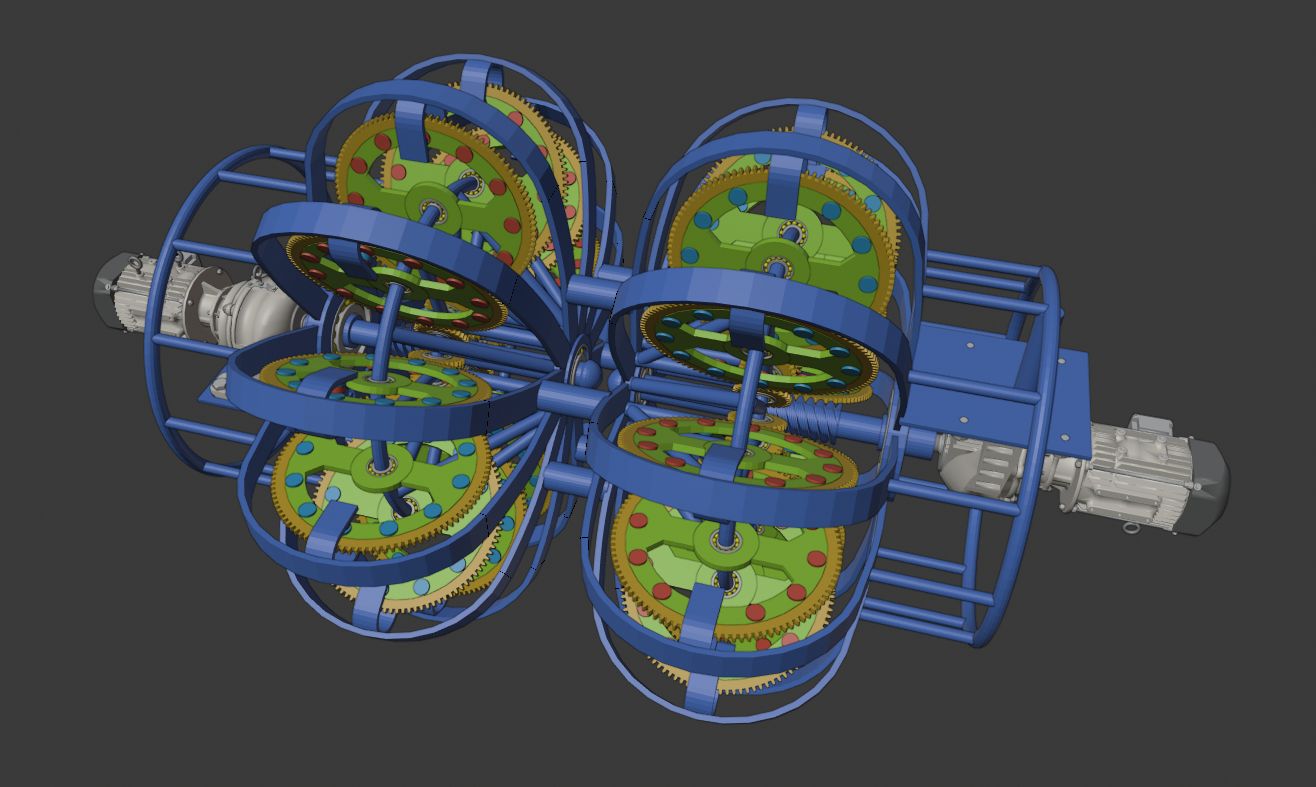
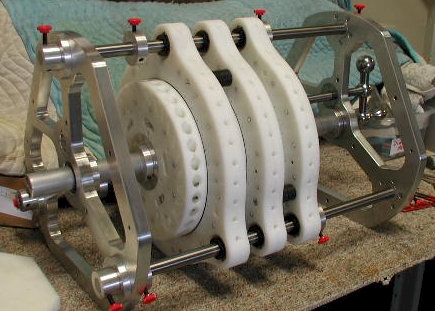
This propulsion is based on magnetic interaction between magnets systems. In every cycle of rotation the magnets are continuously passing thru the external magnetic gate compound of two electromagnets or strong permanent magnets polarized on attraction with magnets in rotating wheels. Once they interact between themselves, the magnetic energy is transformed to a magnetic jolt aimed to up, thus in the same direction as the direction of rotation of the wheels, so the general propulsion force can be achieved. The system can be doubled what is shown on pictures. The propulsion wheels are propelled by two electric motors, with an application of a gears system. The thrust force should be depending from the rotation speed of the wheels and power of the electromagnets/magnets.
Magnetic propulsion.
10 October 2024
Things could also move towards further use of chemical thrusters, which, thanks to new materials, will gain relatively new power, as the weight of spacecraft will be significantly reduced, which will also extend the range of such rockets and rocketplanes. Another way to utilize magnetic fields could involve harnessing the geomagnetic field for propulsion purposes, but this would require the use of very strong magnetic fields. The existing magnetic field of the Milky Way could also be used to propel spacecraft. Current superconducting electromagnets are too heavy, so it is necessary to use magnets several orders of magnitude lighter than those currently available. Perhaps, however, the focus should be on mastering techniques that allow for the ability to control the inertia of matter and gravity, as these techniques could lead to a true breakthrough in the future in the exploration of the known universe. Matter research could also lead, via a completely different path, to the discovery of alternative matter and substances with properties unheard of in our continuum. These will open the door to possibilities so far beyond current technology that it's currently difficult to precisely define them, including the development of propulsion systems that bypass the universal laws of nature in our universe. Various materials currently being developed, such as carbon nanotubes, could bring significant advances in electronics, and as we know, electronics are nothing more than increasingly powerful computers, which further accelerate research, thus serving as the driving force behind technology.
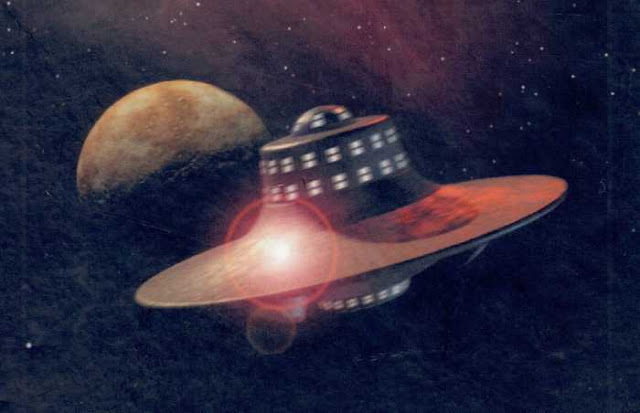
Unknown propulsion. Extraterestial spaceship. - authenticity of the photo -?
Subspace tunnel.
Spaceship.
Unknown method of interdimensional gate, authenticity of the photo -?
Another photo of an unknown vehicle origin, authenticity of the photo -?
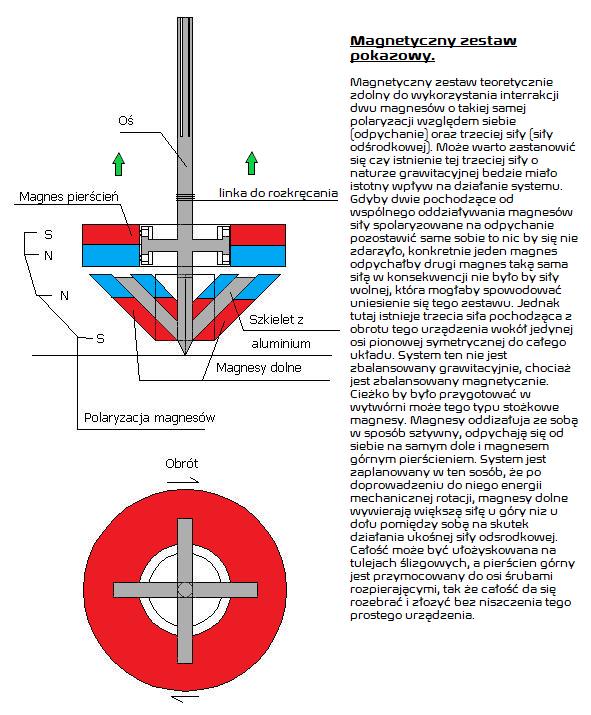
Now, something from my head, or rather, from the depths of my thoughts. A few more words. I made this drawing a long time ago; I had similar thoughts even earlier. I even made a simple magnetic rotor powered by a drill, but it was so unstable that if I really unscrewed it, it would probably shatter into pieces, punching holes in my furniture or windows. If you wanted to build such "revelations," you'd first need to ensure careful workmanship and the right materials. To be honest, I'm not sure about these assumptions, but it seems that certain indications suggest the system could work, although perhaps not exactly in this form (there are also drawing errors resulting from haste). For example, the system is based on centrifugal forces, in this case we're dealing with a non-reactionary system, meaning the lower magnets don't need to exchange energy with the surroundings to experience acceleration. There's no counter-reaction. I also wondered whether the magnetic forces in this case of repulsion would be affected at all by this third gravitational force, whether it would change anything in the overall picture. An experimental phase would certainly be useful here to eliminate false assumptions and hypotheses regarding this solution. In my initial experiment, which, as I mentioned, I performed carelessly, I did not obtain a sufficient answer to confirm the validity of this type of theory. This entire system is incredibly simple, perhaps too simple, or perhaps this is its advantage? This device may be unstable in a gravitational field because the center of gravity is too high. However, this is a device where gyroscopic forces additionally stabilize the system in the horizontal plane. The construction of this device does not have to be made of aluminum, because aluminum, while not a ferromagnetic material, is also not neutral to magnetic fields. It is a paramagnetic material, meaning it interacts weakly with the magnetic field from, for example, neodymium magnets. Therefore, a different material, such as some type of plastic, would be preferable. However, how should the magnets at the bottom, which are supposed to press against the upper ring, be positioned? They would have to have a somewhat unconventional pyramidal shape, additionally truncated into a rhombus at the top and partially at the bottom, so that they could be as close to each other as possible and almost touch each other (of course, as much as the repulsive magnetic forces present in this diagram allow). Ring magnets could be used, but it wouldn't be as compact a solution as in the diagram. They could also have a different inclination angle, which would minimize the dissipation of centrifugal force. There doesn't seem to be a field magnet currently available on the market that can magnetize neodymium magnets, which are manufactured using powder metallurgy, suitable for use in this type of device. I've seen various neodymium magnets on a magnet shop's website, and their shapes are becoming increasingly diverse there's a growing selection, so perhaps the time will come when these types of magnets can be made, for example, to a specific order. The problem of eliminating friction may also be important here, but to verify the device, a solution without bearings or sliding sleeves, etc., will probably be sufficient.
Does Perendev's magnetic device (a magnetic motor with permanent magnets that generates so-called free energy) exist and work? Perendev is supposedly the inventor of a type of magnetic motor based solely on permanent magnets. The inventor's website existed (I don't know if it still exists) presenting ready-made medium- and high-power generators based on magnetic motors. However, after some time, information began circulating online about alleged problems with the company, probably in Germany. It was alleged that a company supplying magnetic devices had been involved in fraud, causing customers to pay for the devices and not receive the goods. Regardless of the fundamental and legal aspects of the case, the issue of magnetic motors has already garnered significant internet attention since the early 2000s. It is known that devices of this type are not supported by scientific facts and, according to current knowledge, they should not work at all. However, as shown by numerous tests of such devices and videos posted in many places on the Internet demonstrating the correctness of the design and functional assumptions, which translate into the real and undeniable operation of magnetic motors to which generators can be connected in order to produce free energy - free electricity, all these current works cannot go unnoticed by the fundamental opponents of such technologies, often depriving them of room for maneuver and the only weapon at their disposal, i.e. the incorrectly interpreted principle of conservation of energy. Given the widespread replication of devices of this type by inventors of all stripes, who present efficient and functioning devices at shows often attended by representatives of various ranks from the energy and automotive industries from around the world, one cannot help but be surprised by the level of prejudice and disapproval they display towards these specific solutions, laconically explaining that they do not want to generate energy from permanent magnets...would it be better to produce tons of radioactive waste from spent nuclear fuel and millions of tons of CO2 from conventional power plants, simply to maintain the current technological direction, which required too much economic effort from previous generations, to now abandon all these technologies just because someone came up with a better idea? In this case, it seems that magnetic motors may not be just a fraud, although the technological foundations seem flawed... Let's look at what a permanent magnet is. A permanent magnet itself is a reservoir of infinite magnetic energy, repulsion or attraction depending on the mutual position of the magnetic poles. The problem is that this energy is technologically unblocked. The magnetic field in this case is static, so it's impossible to generate an electric current through electromagnetic induction. This requires a different approach: constructing a magnetic system functionally so that the interaction of the magnets doesn't cancel out, so that the net forces don't equal zero. This difficult task isn't easy to accomplish, as the magnetic field from permanent magnets inherently tends to cancel out the forces, as the magnet system is rigid. There's a narrow range within which the whole thing can operate; the magnetic poles are directly aligned, making it difficult to construct any device with a positive result. However, I believe that some such devices may not be fraudulent and, in some cases, actually work. History shows that in the case of many great new inventions that then become crucial for the economy, many people are wrong, especially in the case of more revolutionary solutions, while the percentage of the public approving them is often small.Most likely, however, the fuel lobby is still too powerful to allow such devices to be widely used, and as long as energy deposits remain available, they will be exploited for electricity generation. The implementation of magnetic devices in global economies could pose too many complications for any specific global decision to be made. Such complications include, for example, the disruption of financial links supporting individual energy distributors. This would be one of the greatest drawbacks of such technological improvements, posing a major economic catastrophe and likely leading to the collapse of the global energy market. Predictions related to new technological trends usually do not concern these types of energy sources; rather, fusion energy (fusion reactors) and, less frequently, thorium-based reactors are envisaged as the closest potential for energy production. Little is said about free and unconverted energy from magnetic generators, and the topic is largely absent from serious media and scientific and technological publications. Occasionally, less significant themes on this topic arise, but without significant practical results. It's hardly surprising that the topic has been relegated to the margins of technology, given the above. However, the world's resources will eventually run out, and it will be necessary to turn to more universal methods of energy production, not tied to land. Perhaps then the world will remember the magnetic generators and free energy, previously rejected for economic reasons. When this happens, it may not be too late to restore the planet's ecosystem, ruined by humanity's predatory and exploitative approach to nature and its natural resources.