9 September 2020
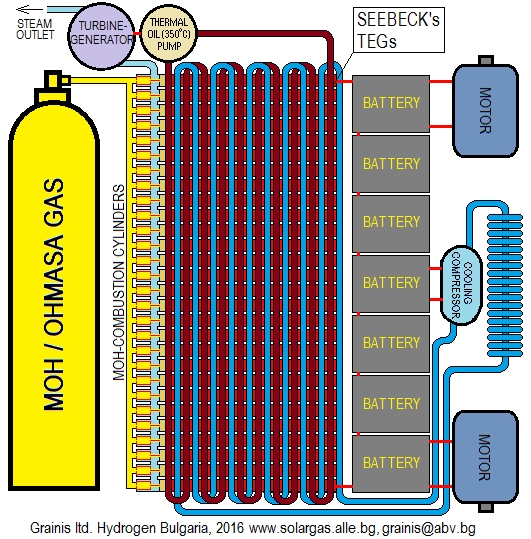
Thermoelectric cells provide the ability to power various devices requiring such energy. The heat source in this case can be plutonium or uranium, or conventional energy carriers in the combustion process. Hydrogen burns cleanly, producing pure water, which can then be decomposed into hydrogen and oxygen and then burned back into water. The problem here is the energy required to decompose the water into its constituent substrates. This can be achieved by using excess current from the same cells. The water can be previously excited with ultrasound to facilitate decomposition, as the water can be pre-activated by ultrasound at the appropriate frequency. Using water prepared in this way, the current required for decomposition is not equal to the energy obtained from burning the hydrogen-oxygen mixture. If this were the case, obtaining energy this way would be absurd, as the energy balance would be zero. Using electrolyzers or a prepared catalyst, such as porous aluminum powder, hydrogen gas can also be obtained from water. Thermoelectric cells are successfully used in space to power spacecraft and probes sent to the outer solar system or beyond. Beyond Uranus' orbit, the amount of sunlight reaching photovoltaic cells is negligible, and these cells would either need to have a large surface area or could be replaced with thermoelectric cells, where the heat source is a plutonium core, which provides long-term energy supply with virtually no change in the supplied current parameters. Using a Stirling engine to generate energy from plutonium could also result in high energy efficiency. There are attempts to use Stirling engines ? plans to use this type of power-producing systems for future missions to Mars, where, along with small, compact nuclear reactors, they would form the core of the energy supply for research centers or habitats on the planet. Another proposal could be to harness the planet's thermal energy. While Mars is a cold planet, likely volcanically inactive to a very limited extent, heat pumps could be used to heat colonization habitats on the planet. An interesting proposal would be to harness solar wind energy to induce energy in circuits. Due to the significant thinning of Mars' atmosphere, this radiation often reaches the ground surface, and it is, after all, an electrical charge that could induce energy in electrical circuits if appropriate technological solutions were implemented. Not to mention the fact that people and equipment could be exposed to radiation whenever someone enters the radiation zone without protection.