9 September 2020
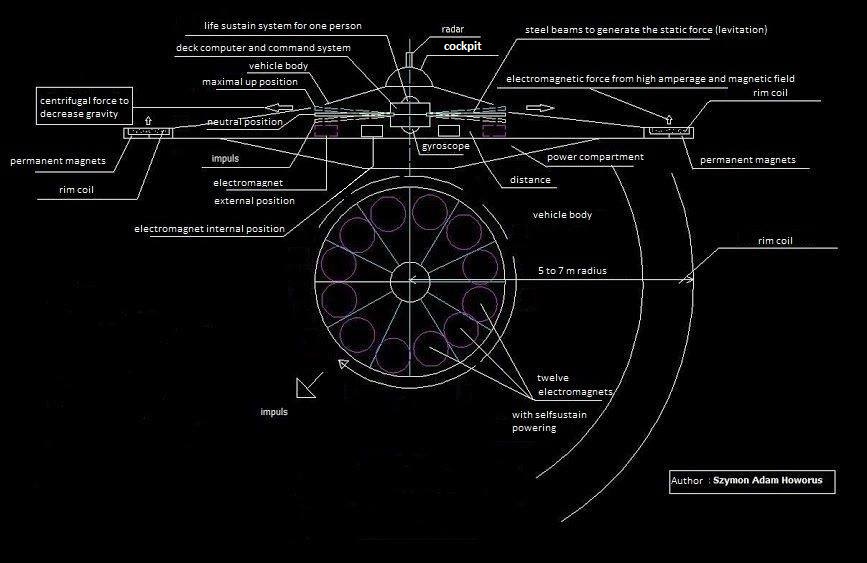
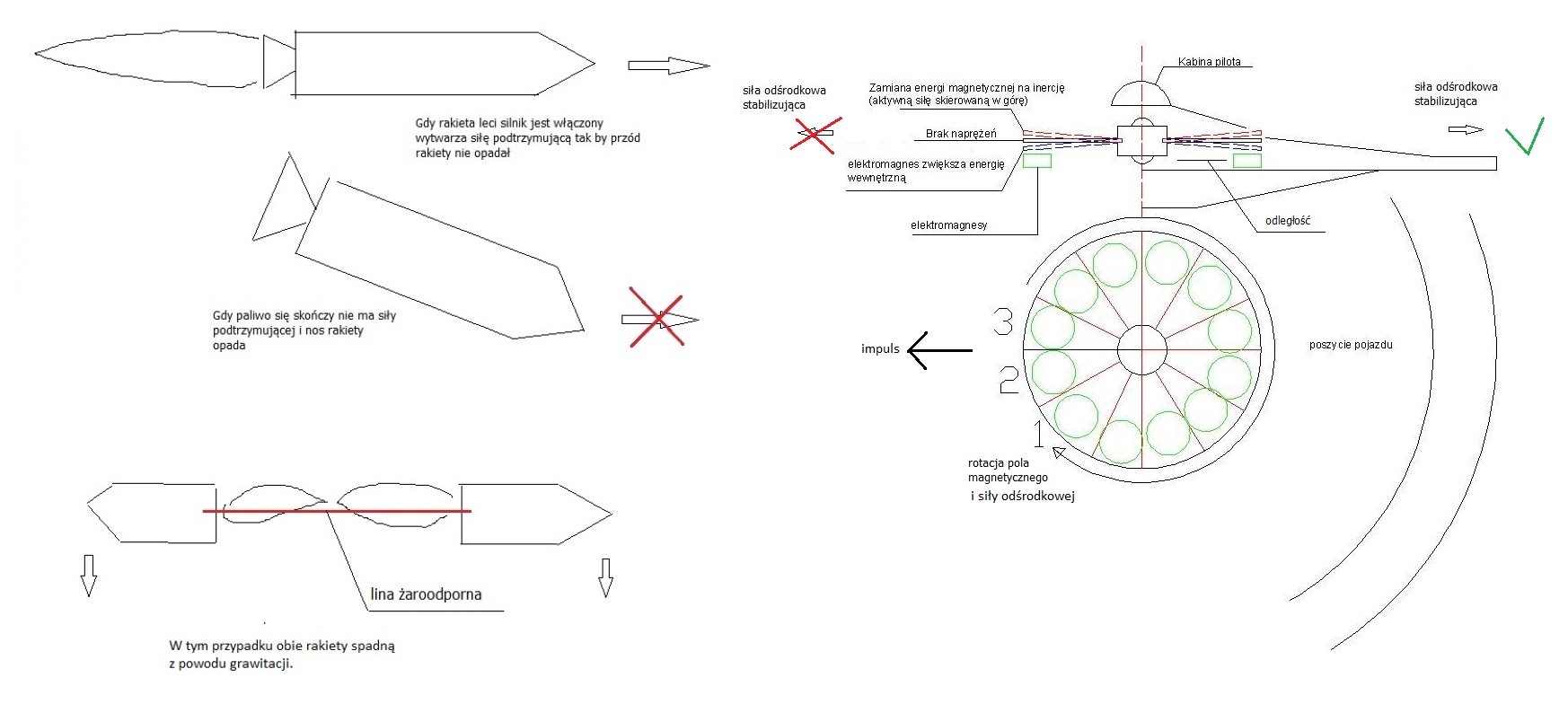
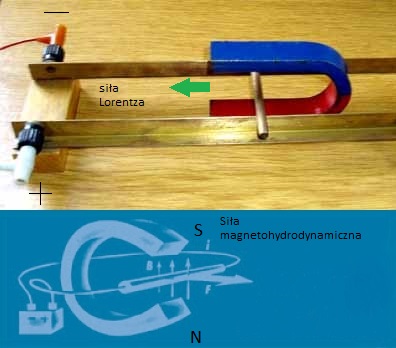
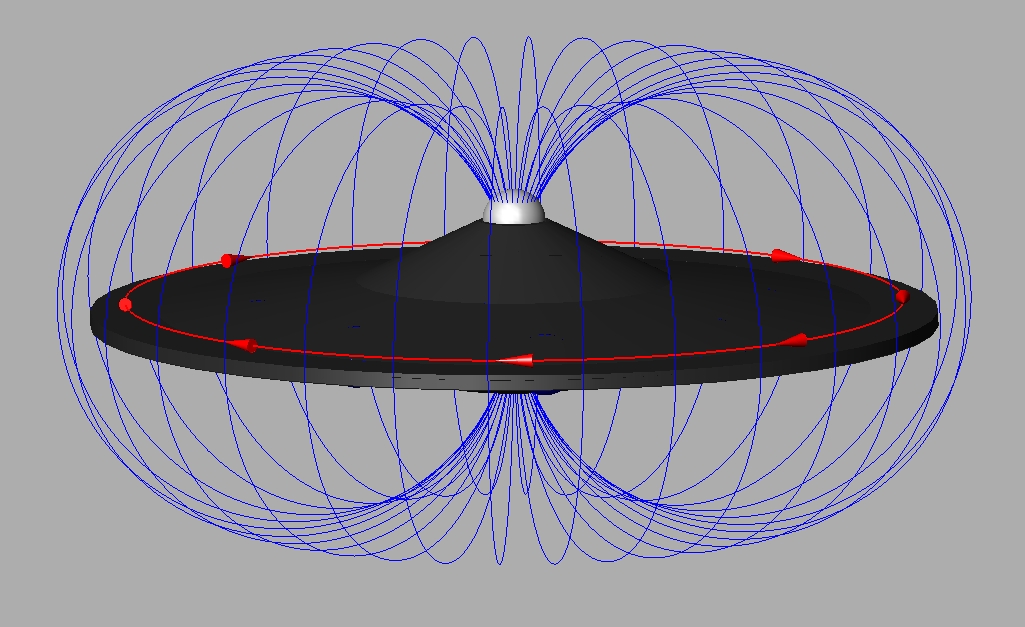
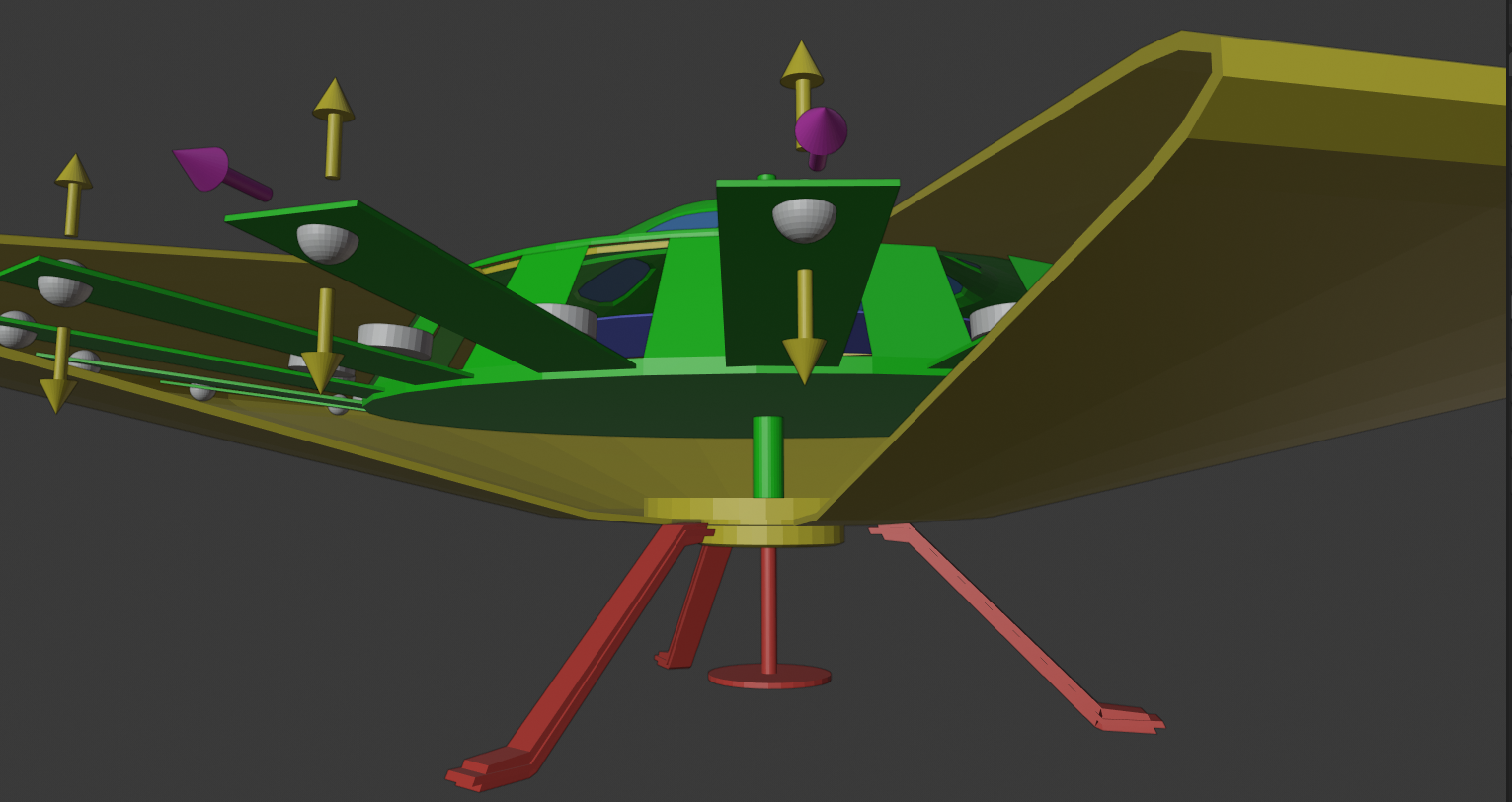
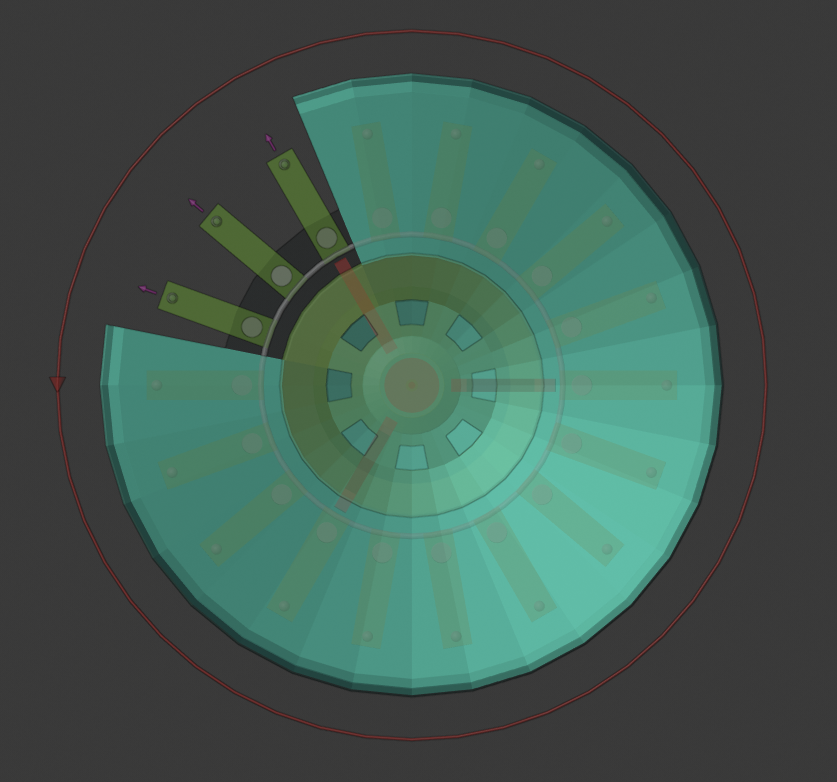
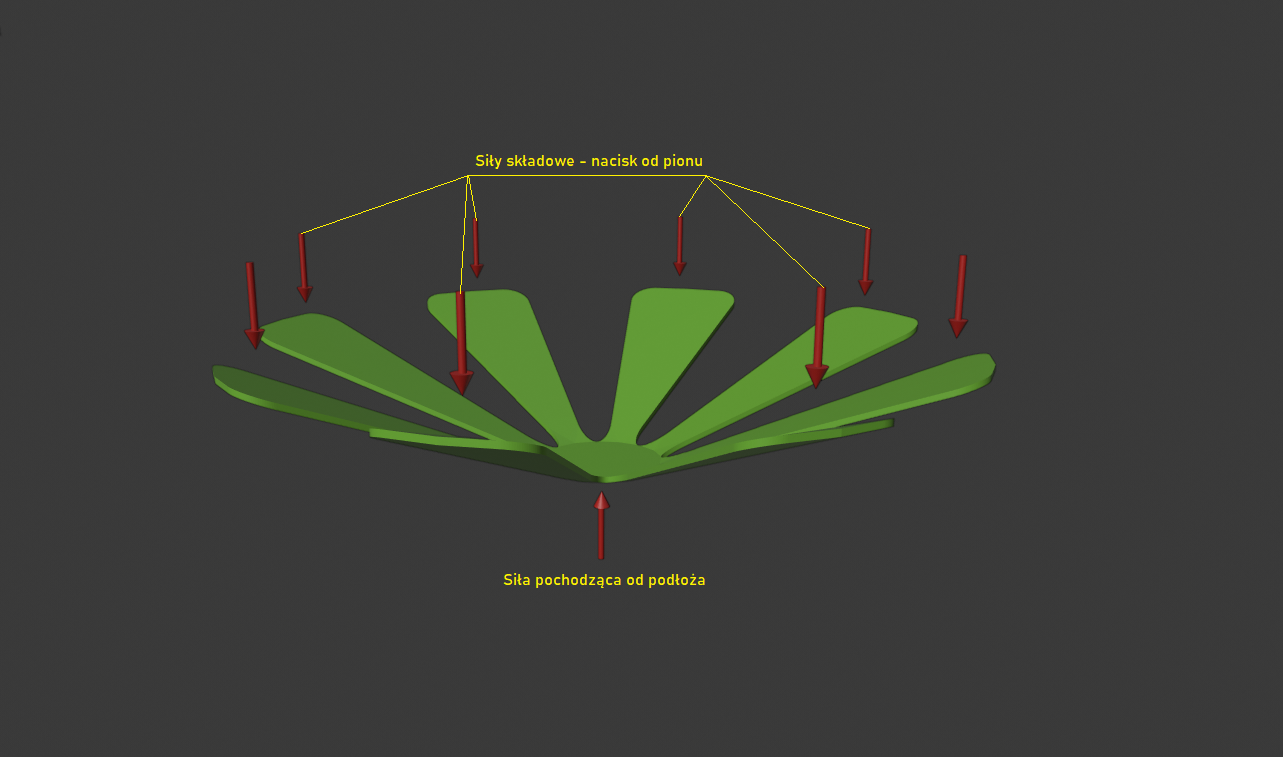
The propulsion system below utilizes centrifugal forces acting on moving structural elements, which are aligned and activated to create a vortex composed of centrifugal forces. The main propulsion in this case is derived from the Lorentz force generated by coils in a magnetic field surrounding the entire propulsion system. The horizontal support elements should be directed slightly upwards and generate the force needed to counteract the gravity of objects such as planets or moons. Vertical launch would involve vibrating horizontal elements to prepare the system for the action of a magnetic coil immersed in a field of permanent magnets or high-strength electromagnets. The horizontal support elements should operate so that centrifugal force pulls them outward from the vehicle, i.e., around its circumference, as the vehicle is intended to be disc- or saucer-shaped. Theoretically, the vehicle could operate solely on centrifugal force, but then the moving elements would have to be positioned at a greater angle to the horizontal, which would interfere with achieving a saucer-shaped design and could result in a less aerodynamic overall design. It is worth considering whether the oscillating elements should operate simultaneously and synchronously or sequentially, as this can be a fundamental issue for the operation of the drive mechanism of this type of vehicle or devices based on similar physical phenomena. Oscillating elements are susceptible to failure due to material fatigue, so they should be made of a material with the lowest possible deformation memory, such as iridescent steel or similar. The magnetic mechanism itself, driving the oscillation of the oscillating elements, could involve the use of electromagnets placed as close to the surface as possible, while maintaining the necessary gap. Vibrations cannot exceed a certain critical value, beyond which the drive system would be destroyed, nor can they be amplified resonantly, which would result in loss of control. The modulus of the vibrating elements should be calculated so that the vibration frequency and amplitude, which directly determine the generated centrifugal force, are optimal. The most important parameter of the supporting element should be adjusted: its cross-section and basic length. The electromagnets should probably be mounted on rails so that their position can be controlled during the operation of the propulsion mechanism, meaning their position under the vibrating elements should be adjustable along most of their length. The angle of inclination relative to the horizontal of the vibrating elements should likely range from 15 to 30 degrees. The general rule would be that the greater the inclination angle relative to the horizontal, the lower the vehicle's stabilization, but the vertical force gradient simultaneously increases. This propulsion system could also be stabilized by a gyroscope, but it should stabilize automatically at higher speeds, which depends on the inclination angle of the vibrating elements. The system requires significant precision to fine-tune the interplay of all the elements in the propulsion mechanism. This is not a simple spacecraft propulsion system to design, but it seems plausible in terms of operational reliability and theoretical foundations. It is a system of mechanical and magnetic propulsion with advanced electronic control, and it will not be cheap if anyone attempts to implement it. Regarding the propulsion mechanism's height, the higher the height, the more stabilizing the vehicle's mass, closer to the ground. This mass will simply gravitate beneath the vehicle, resulting in the vehicle stabilizing along its vertical axis. In space, however, this very mass can act as a flywheel and pose difficulties in piloting, especially during tight turns or U-turns. However, it would be necessary to consider the maximum height to which this relationship should be applied. This would require experimental research, but it is known that experimentation is not always economically viable and can be costly, especially in projects of this type. Maneuvers in space with this type of vehicle would involve the use of a coil?braking and accelerating. Lateral maneuvers would be possible by asymmetrically redirecting power to the oscillators. For more effective braking purposes, one could also consider a programmable system for changing the deflection of the oscillators to the reverse position, which would then work in the opposite way to the standard phase, enabling more effective braking, turning maneuvers or any other change in the flight trajectory.
Principle of propulsion.